How 3D print works – technology, materials, and possibilities
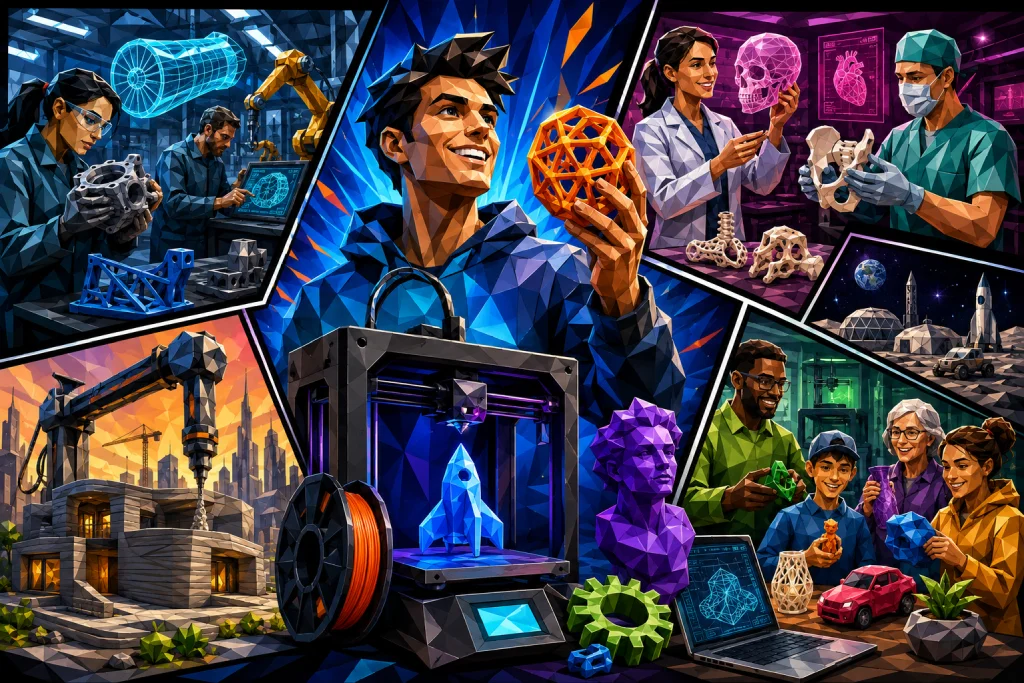
3D print has revolutionized the way we manufacture and create. The technology, also known as additive manufacturing, builds objects by adding material layer by layer, based on a digital 3D model. This innovative concept has made it possible to manufacture everything from rapid prototypes and unique spare part solutions to detailed artworks and ready-to-use products.
At our facility, we already see 3D print being used in advanced construction, where materials like concrete are shaped directly on-site. On a global level, the market for 3D print was valued at 17 billion USD in 2023, and growth rates of up to 20% annually show that the technology is still in rapid development.
This article covers everything you need to know about 3D print. You get an introduction to the technologies, materials, and processes that drive development, and practical tips for choosing the right equipment. Whether you are a beginner or a professional, you will find inspiration to utilize 3D print in both small and large projects.
Want help getting started or finding the best prices? Visit 3dprintingprice.in and explore the possibilities for both equipment and 3D print services.
(3D print price)
What is 3D print, and how does it work?
3D print, or additive manufacturing, is a process where physical objects are built up layer by layer using a 3D printer. The technology begins with a digital model that is translated into a series of precise instructions for the printer. This approach allows for the creation of complex shapes with minimal material waste.
There are two most widespread types of 3D print: FDM (fused deposition modeling) and resin print. FDM is the most common method and uses filament – a plastic thread – which is melted and deposited layer by layer. FDM printers are often used for functional prototypes, gadgets, and decorative objects. They are a popular choice among hobbyists as they are budget-friendly, easy to use, and support a wide range of materials.
Resin print is known for its high resolution and fine details. Here, a UV-curing resin is used, which is hardened layer by layer with a light source such as a laser or LCD. Resin print is particularly suitable for models with small details, such as jewelry or dental equipment, but requires more post-processing, including cleaning with isopropyl alcohol and UV-curing. Although resin printers are often more expensive to use due to material requirements, their precision is unsurpassed.
A significant difference between the two technologies is the material: FDM printers typically use filament spools that cost between 1,800-3,600 INR for 1 kg, while resin printers require UV resin, which starts from approximately 3,600 INR per liter. Both methods have their strengths, depending on your project and needs.
Regardless of which technology you choose, 3D print is a flexible and efficient method for realizing your ideas – from simple designs to advanced prototypes.
FDM printers often work with filament on spools, while resin printers require extra processes, including cleaning with isopropyl alcohol and UV-curing. Regardless of the type, all prints start with a digital 3D model that is converted into a printable file via slicing software.
Which types of 3D printers exist, and what are they used for?
3D printers are divided into several categories based on their technology and application. Each printer type has unique properties that make it ideal for specific tasks – from simple hobby models to advanced industrial solutions.
FDM printers
Fused Deposition Modeling (FDM) is the most popular technology among hobbyists and small businesses. These printers work by melting filament, which they deposit layer by layer to create a model. FDM printers, such as the Longer LK4X, cost around 24,000 INR and are known for their user-friendliness. They offer advanced features like automatic bed-leveling, filament sensors, and power recovery. FDM printers are often used to manufacture prototypes, toys, and practical gadgets.
SLA printers
Stereolithography (SLA) printers use a UV-curing resin that is shaped using a laser or LCD light. These printers are known for their high resolution, which can reach down to 0.025 mm, and are often used for detailed models such as jewelry, dental equipment, and medical prototypes. Resin printers, however, require more post-processing and handling of toxic materials.
SLS printers
Selective Laser Sintering (SLS) is an advanced technology that uses a laser to melt powder materials like nylon. This method is ideal for creating functional parts with complex geometries. SLS printers are often used in the automotive and aerospace industries, where strong and precise components are necessary.
Multi Jet Fusion (MJF)
HP’s Multi Jet Fusion printers offer faster production speeds than SLS and higher precision. This technology is ideal for small-scale serial manufacturing, especially when uniform quality and detail are required in every single part.
Binder Jetting
Binder Jetting is a technology used for metals such as steel and titanium. This method is used in high-tech sectors like aerospace, where precision and strength are crucial. A major advantage of Binder Jetting is the possibility to produce complex metal parts without the need for expensive tools.
Modern printers and functions
Regardless of the technology, 3D printers consist of key components like the hotend, gantry, and extruder, which work together to ensure precise prints. Advanced models like the Longer LK4X are equipped with dual-gear extruders that ensure better filament control and reliability.
The choice of printer type depends on your needs. FDM printers are perfect for beginners and creative projects, while SLA and SLS printers offer the precision and strength required in professional applications. With the latest technologies like MJF and Binder Jetting, even more opportunities open up to realize complex ideas and products.
Which materials are used in 3D print, and what are their properties?
Materials are the core of any 3D print process. They determine how your print looks, feels, and functions. From budget-friendly solutions to high-tech materials, there is a myriad of options that can be adapted to different projects.
PLA – Easy to work with and environmentally friendly
PLA (polylactic acid) is one of the most popular materials for 3D print, especially among beginners. It is biodegradable and manufactured from corn starch, making it an environmentally friendly choice. PLA is easy to work with, requires no heated 3D printer cabin, and has a 3D print temperature of 190–220°C. It is often used for decorative objects, toys, and prototypes. A spool of 1 kg typically costs 1,800–3,000 INR.
PETG – Strong and resistant
PETG (polyethylene terephthalate glycol) combines strength and flexibility and is resistant to moisture and chemicals. It is ideal for functional parts that require durability, such as bottles or outdoor applications. PETG is printed at 220–250°C and provides semi-transparent results, making it popular for both functional and aesthetic projects.
ABS – Durable and heat-resistant
ABS (acrylonitrile butadiene styrene) is known for its strength and heat resistance and is used in products like LEGO bricks and car parts. However, it requires a closed printer and a print temperature of 230–250°C to prevent warping. ABS is a preferred choice for functional and mechanical parts.
TPU – Flexible and robust
TPU (thermoplastic polyurethane) is a flexible material used for shock-absorbing objects like phone covers, shoes, and car parts. It is both durable and elastic, making it ideal for parts that must be able to bend and stretch. TPU is printed at 210–230°C and costs approximately 3,600–6,000 INR per kg.
Special materials – From metal to glow-in-the-dark filaments
There are many special materials that provide unique possibilities:
- Metal filaments: Mixtures of plastic and metal powder that create a metallic finish.
- Glow-in-the-dark filaments: Perfect for decorative projects that need to glow in the dark.
- Soluble materials (PVA): Used as supports and dissolved in water, facilitating work with complex models.
Future materials
The technology behind 3D print materials is constantly developing. New types like biocompatible materials for medical implants and budget-friendly metal filaments promise to expand the possibilities further. Whether you want a simple PLA print or an advanced functional model, there is a material that fits your needs.
With the right knowledge and the right material, you can get the most out of your 3D printer, whether you print beautiful decorative objects or complex functional parts.
How does the 3D print process work from design to finished product?
The process of 3D print starts with an idea and ends with a physical product, but there are several important steps along the way. By understanding and optimizing each step, you can ensure that your 3D print becomes a success.
1. Design: From idea to digital model
Everything starts with a 3D model that can be designed in software like Tinkercad, Fusion 360, or Blender. These programs allow you to create everything from simple shapes to complex structures. Once the design is finished, the model is typically exported as an STL file, which slicing software can process. STL files describe the object’s surfaces with a series of triangles, while 3MF files save additional data like colors and textures.
2. Slicing: Translation to the printer’s language
Slicing software like Cura, PrusaSlicer, or Simplify3D converts your model into a G-code file that contains precise instructions for the printer. Here, settings are adjusted such as:
- Layer height: Typically between 0.1 and 0.3 mm for FDM printers. A lower layer height provides a higher level of detail but increases print time.
- Infill: The proportion of material inside the model, ranging from 10% for decorative prints to 50% or more for functional parts.
- Support: Used to support overhangs and complex structures, which are removed in post-processing.
After slicing, you get a preview of the print so you can check that all layers and support structures are correctly placed.
3. Printing: From digital to physical
When slicing is finished, the file is transferred to the printer via USB, SD card, or a wireless connection. The printer follows the G-code instructions to melt the filament or cure resin layer by layer. During printing, it is important to monitor the first layers, as these are crucial for success. Modern printers with features like automatic bed-leveling make this process easier.
4. Post-processing: The final touch
When the print is finished, post-processing is often required to improve its appearance and functionality. This can include:
- Removal of supports using tools like pliers or a scalpel.
- Sanding of surfaces for a smooth finish.
- Painting or coating to add color and protection.
For resin prints, additional UV-curing is required to ensure strength and durability.
Practical tips for a successful print process
- Ensure that the print bed is clean and correctly leveled to ensure that the first layer sticks firmly.
- Use the correct temperatures for both the hotend and bed based on the filament’s specifications.
- Start with small test models to optimize your settings before you print larger and more complex objects.
From design to finished product, 3D print is a process filled with possibilities and learning. With the right tools and a little experience, you can create fantastic objects that bring your ideas to life. Visit 3dprintingprice.in to find the best equipment and the materials that fit your needs.
Which software is used for 3D modeling and slicing?
To succeed with 3D print, it is important to choose the right software. There are two main categories of programs: 3D modeling software to design your models and slicing software to prepare them for print. By combining these tools, you can create everything from simple prototypes to complex functional parts.
3D modeling software: From idea to design
3D modeling software allows you to create digital models of your ideas. The choice of software depends on your experience level and the complexity of the project:
- Tinkercad: A free, browser-based tool, perfect for beginners and education. With its intuitive drag-and-drop interface, you can quickly make simple designs.
- Fusion 360: An advanced tool that combines parametric design, simulation, and CAD/CAM functions. Free for students and hobbyists, Fusion 360 is ideal for engineers and designers.
- Blender: Open source and free, Blender is known for its advanced tools for animation and rendering. It is often used in film and game development but can also be used for 3D print.
Slicing software: Translate the model to the printer’s language
Slicing software is the next step in the process. It transforms your 3D model into a G-code file that your printer can understand. Here are some of the most popular slicing programs:
- Cura: The most widespread slicing software, supporting over 400 printers. Cura offers both basic and advanced settings, including layer height, infill, and support placement.
- PrusaSlicer: A free and powerful tool optimized for Prusa printers, but compatible with many other models. It offers an easy start for beginners and advanced features for experienced users.
- Bambu Studio: A proprietary solution designed specifically for Bambu Lab printers. It ensures flawless setup and is well-suited for multi-material print.
- Simplify3D: A paid software with extensive functions and precision. It is a good choice for professionals who want full control over their prints.
How do they work together?
To succeed with 3D print, 3D modeling and slicing software must work hand in hand. First, you design your model in a modeling program and export it as an STL or 3MF file. Then, you import the file into slicing software, where you adjust settings like layer height, infill, and support structures. Once the slicer has generated a G-code file, it is ready to be printed.
How do you choose the right software?
- For beginners: Start with Tinkercad for design and Cura for slicing. Both are free and easy to use.
- For advanced users: Consider Fusion 360 or Blender for design and Simplify3D or PrusaSlicer for slicing to get full control over your projects.
- For specific printers: Use proprietary solutions like Bambu Studio or PrusaSlicer for the best compatibility and flawless print setup.
By choosing the right software, you can create impressive results and turn your ideas into reality. Regardless of your experience level, these tools offer everything you need to get started. Visit 3dprintingprice.in to get more information and find the software that best fits your needs.
How to choose the right 3D printer?
Choosing the right 3D printer is about finding a model that matches your needs, your budget, and your desired result. Here are some of the most important factors you should consider to ensure you get the most out of your investment.
FDM printers – The obvious choice for beginners
FDM printers are the most popular technology among hobbyists and small businesses. They use filament that is melted and deposited layer by layer, making them versatile and easy to use. Models like the Longer LK4X are popular choices for beginners with features such as:
- Automatic bed-leveling: Adjusts the print bed level for optimal first-layer adhesion.
- Filament detection: Stops the print if the filament runs out and resumes it when new filament is inserted.
FDM printers are budget-friendly with prices from approximately 18,000 INR, making them ideal for learning and smaller projects.
SLA printers – When precision is paramount
SLA printers use UV-curing resin to create models with high resolution and smooth surfaces. These printers are perfect for detailed designs like jewelry, dental models, and prototypes. SLA printers, however, require more post-processing and higher initial costs, with starting prices around 36,000 INR.
Print size and build volume
Consider how large you want your objects to be. Standard desktop printers offer a build volume of around 220 x 220 x 250 mm, which is sufficient for most hobbyists. If you plan larger projects, models with a larger build volume, such as 400 x 400 x 500 mm, may be necessary.
Advanced features: Save time and material
Modern printers offer features that make the print process easier and more efficient:
- Power recovery: Resumes the print process after a power failure.
- Dual extruders: Allows printing with two different materials or colors at the same time. This is particularly useful for complex models that require soluble supports or different colors.
Which questions should you ask before you buy?
- What is your budget? Starter models cost around 18,000 INR, while advanced printers can cost 120,000 INR or more.
- What do you want to print? Simple designs require an FDM printer, while detailed or industrial models may require an SLA or SLS printer.
- Which materials do you want to use? Check if the printer supports materials like TPU, PETG, or resin.
Recommendations for different users
- Beginners: FDM printers like the Longer LK4X are budget-friendly and user-friendly.
- Advanced users: SLA printers like the Anycubic Photon offer high precision and professional results.
- Businesses: Consider SLS printers for functional parts or larger build volumes.
Choosing the right 3D printer is an important step toward realizing your creative ideas. Whether you are a beginner or a professional, you can find a printer that meets your needs. Visit 3dprintingprice.in to compare prices and find the perfect printer for your next project.
What can you make with a 3D printer?
With a 3D printer, you can create everything from functional objects to artistic masterpieces. The technology is used widely across industries and adapts to different needs – whether in industry, the healthcare sector, or the home workshop.
Industrial applications: From prototypes to production
In industry, 3D print is used for rapid prototyping, which saves time and costs. Car manufacturers like BMW use the technology to manufacture lightweight components that reduce weight and improve fuel efficiency. In the aerospace industry, companies like Airbus produce strong and light parts that can withstand extreme conditions.
The construction industry is experimenting with 3D print of buildings and bridges. For example, 3D printed houses have been erected in Dubai in under 24 hours, demonstrating the technology’s potential to revolutionize construction.
Medical applications: Tailored solutions
The healthcare sector is one of the biggest driving forces behind 3D print innovation. The technology is used to produce biocompatible implants, such as hip and knee prosthetics, that fit the patient’s anatomy perfectly. Additionally, 3D print is used to manufacture surgical tools and models that surgeons can practice on before complex operations.
Home use: Creative and practical solutions
Home users benefit from the 3D printer’s versatility for both practical and creative projects. It can be anything from printing a mobile holder for a bicycle, creating decorative vases, or even repairing broken appliances with tailored spare parts. A good example is a ukulele neck, where 50% infill ensures strength and durability.
For decorative prints like figures and vases, infill can be reduced to 10-15%, which saves both time and material. Materials like PLA are particularly popular among home users due to their ease of use and low costs.
Future applications of 3D print
The technology is developing rapidly and opening up even more application possibilities. For example, research is being conducted into 3D printing food and biological tissue. NASA is experimenting with using 3D print to build bases on Mars using local materials, while the fashion industry is starting to produce tailored garments.
With a 3D printer, the possibilities are almost endless. From innovative solutions for everyday small problems to advanced industrial projects, the technology can help you realize your ideas. Visit 3dprintingprice.in to find a printer that fits your needs and explore your creative limits.
What are the advantages and limitations of 3D print technology?
3D print technology offers a unique combination of flexibility and innovation, making it possible to create everything from simple prototypes to advanced, functional objects. The technology has many advantages but also requires an understanding of its limitations.
Advantages of 3D print technology
3D print offers a number of advantages that make it an attractive choice for both businesses and hobbyists:
- Rapid prototyping: With 3D print, ideas can be translated into physical models in a few hours, significantly reducing development time.
- Complex designs: The technology makes it possible to create geometries that traditional manufacturing methods cannot handle, e.g., intricate lattice structures and organic shapes.
- Less material waste: Additive manufacturing uses only the necessary amount of material, making it more sustainable compared to subtractive methods like milling.
- Sustainable materials: Materials like PLA, which is biodegradable, and filaments made from recycled plastic, highlight the technology’s green potential.
- Local production: 3D print enables manufacturing close to the consumer, reducing transport costs and environmental impact.
An example of the technology’s versatility is its use in disaster relief. Here, 3D printers can be used to quickly manufacture tools or spare parts that can be crucial in emergency situations.
Limitations of 3D print technology
As with all technologies, there are also challenges associated with 3D print:
- Long print time: Large or complex models can take several hours or days to print. For example, a detailed model of 20 cm can take up to 24 hours.
- Technical requirements: The technology requires a certain degree of technical knowledge, especially when it comes to setting up the printer and adjusting parameters like layer height, infill, and temperature.
- Errors and maintenance: Common problems like layer shifting or poor adhesion to the print bed can lead to failed prints. These errors are often due to loose belts or dirt on the print bed.
- Limitations in materials: Not all materials can be used with all printers. For example, ABS requires high temperature and a closed cabin, which is not available on all FDM printers.
How do you solve the most common challenges?
Although the limitations can seem overwhelming, there are many ways to minimize the problems:
- Long print time: Reduce layer height or choose a faster printer if time is critical. For example, newer printers like the Bambu Lab X1 Carbon offer significantly higher print speeds.
- Technical requirements: Use slicing software like Cura, which offers preset profiles for many printers, making it easy to get started.
- Layer shifting: Check and adjust the belt tension regularly, and ensure the print bed is correctly leveled.
- Material selection: Research which materials your printer supports and choose filaments that are easy to work with, such as PLA or PETG.
A world of possibilities and challenges
3D print technology has opened up a world of possibilities where complex design and sustainable production go hand in hand. Although there are challenges associated with the technology, most problems are manageable with the right knowledge and setup. Whether you are a beginner or a professional, 3D print can help you realize your creative and practical projects. Visit 3dprintingprice.in to get more information and the best solutions for your next 3D print project.
What does the future look like for 3D print?
The future of 3D print looks bright and offers unimagined possibilities within several industries. The technology is developing at a rapid pace, driven by progress in materials, speed, and precision. Here is a look at some of the most promising directions that 3D print is moving in.
Metal print: From idea to reality
Metal print is becoming increasingly accessible and is already a gamechanger within industries like aerospace and medicine. This technology makes it possible to produce strong, light, and complex metal parts that would otherwise be difficult to manufacture with traditional methods. The market for metal print is growing at an impressive rate and is expected to hit 7 billion USD by 2030.
Multi-material systems: A new era for creativity
Systems like Bambu Lab’s filament management allow printing with up to 16 colors and materials in one print. This makes it possible to create advanced models with details like textures and color transitions that were previously only possible through manual post-processing. The technology is expected to revolutionize prototypes and product development.
Construction: Faster and cheaper erection
3D print is already being used to erect buildings and bridges. In Dubai, 3D printed houses have been built in less than 24 hours, reducing costs and increasing speed. Construction is also becoming more sustainable, as the technology minimizes material waste and uses environmentally friendly materials.
Medicine: Bioprinting and personal solutions
Bioprinting is one of the most exciting applications of 3D print. The technology is working on creating organs and tissues that can be used for transplants. Simultaneously, 3D print is used to manufacture patient-tailored prosthetics, implants, and surgical models, which has already significantly improved patient care.
Space: Building on the Moon and Mars
NASA and ESA are experimenting with using 3D print to erect buildings and structures on the Moon and Mars. By using local materials like lunar dust or Martian soil, the technology can make it possible to establish sustainable settlements without the need to transport large quantities of materials from Earth.
Which technological trends will dominate the future?
- Automation: Integration of robotics and AI in 3D print will make it possible to produce even faster and more precisely.
- Sustainability: Focus on recyclable materials and energy efficiency will continue to be a driving force.
- Bioprinting: The possibility to print functional organs and tissues will revolutionize the healthcare sector.
- High-speed print: New technologies promise to reduce print times significantly, making the technology even more attractive for mass production.
The future of 3D print is both exciting and challenging. The technology has the potential to change our world by making production more efficient, sustainable, and accessible. Visit 3dprintingprice.in to stay updated on the latest trends and find the right solution for your needs.
Which 3D printer is best for beginners?
FDM printers like the Longer LK4X are ideal for beginners. They are budget-friendly, easy to use, and offer features like automatic bed-leveling and filament detection. This makes it simple to make prints without great technical experience and at an affordable price.
Which materials are best for 3D print?
PLA is the most popular material for beginners, as it is easy to work with and environmentally friendly. PETG is stronger and suitable for functional parts, while ABS requires more experience, as it requires higher temperatures and a closed printer to avoid warping.
How long does a 3D print take?
The 3D print time varies depending on the model’s size and complexity. A simple model can take 1-2 hours, while larger or detailed models can take over 24 hours. Faster printers and reduced layer height can shorten the 3D print time.
Which errors are most common with 3D print?
The most common errors include layer shifting, poor adhesion to the 3D print bed, and clogging of the nozzle. These errors can often be solved by adjusting belt tension, cleaning the print bed, and ensuring that the slicer settings match the material.
What can you make with a 3D printer?
3D printers are used for everything from prototypes and spare parts to artworks and decorative objects. Home users often print gadgets, kitchen tools, or figures, while industry uses the technology for functional parts and complex structures.
What does it cost to 3D print?
The price depends on the material and 3D print size. PLA typically costs 1,800-3,000 INR per kg, and a small model can cost 60-120 INR in material. More advanced materials like resin or metal are more expensive but provide higher detail and durability.
What have we learned about 3D print?
3D print is a technology that opens up a world of creative and practical possibilities. With its ability to create everything from simple prototypes to complex components, 3D print has become an indispensable resource for both hobbyists and professionals.
We have seen how the technology can be used in different sectors:
- Materials: From beginner-friendly PLA filaments to advanced metal and nylon powders, 3D print offers a wide range of solutions for every need.
- Printer types: FDM printers are perfect for fast and budget-friendly solutions, while SLA printers impress with their high level of detail and smooth surfaces.
- The future: With progress like bioprinting, sustainable materials, and high-speed production, 3D print promises to transform both industry and everyday life.
How do you get started with 3D print?
If you are new to 3D print, you can start with a user-friendly FDM printer like the Longer LK4X and a material like PLA, which is easy to work with and budget-friendly. For more advanced projects, you can explore SLA or SLS printers that offer higher precision and durability.
Regardless of your experience level, it is important to choose the right equipment and material that fits your project. At 3dprintingprice.in, you can find everything you need to get started, including detailed guides, price overviews, and recommendations for both printers and materials.
3D print is not only a technology – it is an opportunity to realize your ideas and create something unique. So why not take the first step today? Visit 3dprintingprice.in and explore how 3D print can bring your visions to life.