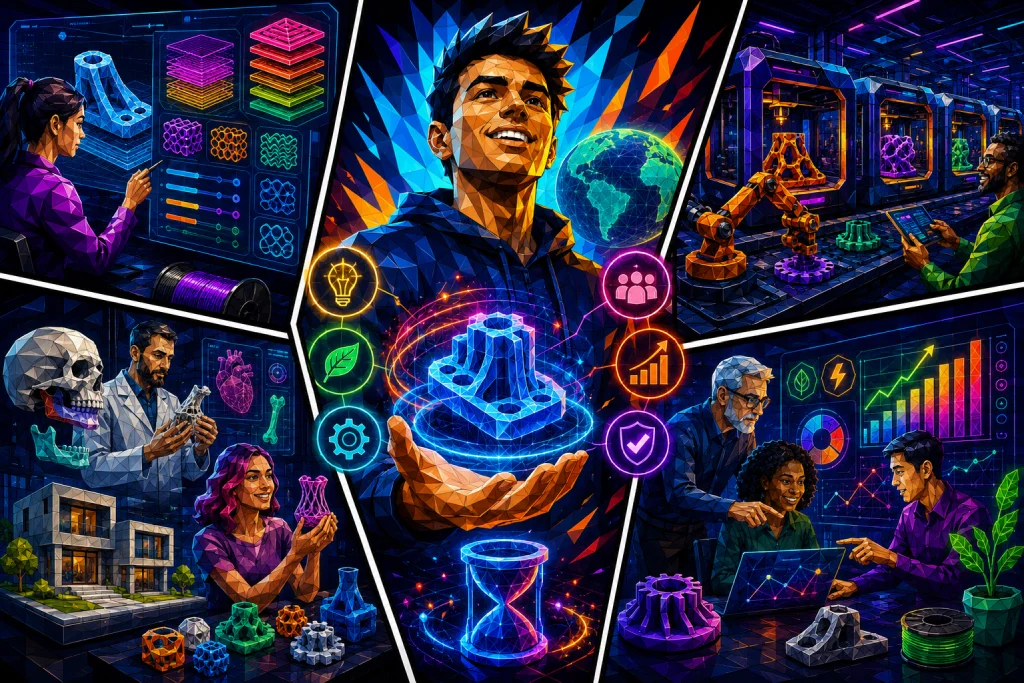
How 3D print changes the way we create, produce, and think
Many describe 3D print as a decisive method for manufacturing – but why has the technology gained such great importance? Is it only a practical solution for hobby use, or does it fundamentally change the way we develop products and work with materials?
3D print gives both companies and private individuals the opportunity to design and manufacture objects quickly, locally, and with great flexibility. It changes not only the production but also our view of what is possible. This article explains how 3D print contributes to innovation, reduces resource consumption, and makes it easier to adapt solutions to individual needs.
3D print as a key to innovation
With 3D print, an idea can go from sketch to physical prototype in a few hours. This speed changes the way products are developed. Companies and developers get much faster access to test, adapt, and improve their solutions – without spending time and money on mould tools or series production.
The use of 3D print in, among others, the health sector, the automotive industry, and artistic projects shows how broadly the technology is applied. Regardless of the purpose, it is about shortening the path from thought to functional product – and thus making innovation more accessible to more people.
Sustainability and reduction of waste
3D print only uses the necessary amount of material by building up items layer by layer. In contrast to traditional methods, which often cut material away and leave waste, 3D print significantly reduces material waste.
By producing locally, the need for long transport and large warehouses is reduced. This cuts down on CO₂ emissions and makes the production chain both shorter and more efficient. In a time where companies demand more climate-friendly solutions, 3D print provides a concrete contribution.
Tailored solutions and personal customisation
3D print is particularly well-suited for products that must fit the individual. Everything from hearing aids and dental prosthetics to figures, jewellery, and art objects is manufactured today based on individual needs and preferences.
Companies and private individuals avoid mass production and large tooling costs. Instead, they can have something manufactured that is adapted precisely to the purpose. This moves production from standard solutions to personal choices – and opens up new business models at our facility.
How 3D print changes the production landscape
3D print moves production closer to those who need the products. Companies avoid waiting for deliveries from distant suppliers and can instead manufacture components directly in their own production – quickly and on demand.
By placing manufacturing locally, the supply chain becomes shorter and less vulnerable. This provides better control, faster delivery, and lower dependence on global distribution links.
3D print and the labour market of the future
3D print changes which skills are in demand on the labour market. Companies need employees with experience in digital modelling, technical drawing, and design understanding – not only in production but also in education, artistic projects, and entrepreneurship.
More schools and colleges are already including 3D print in their teaching. Students learn to translate ideas into concrete objects and gain practical experience with digital creation. This prepares them for a labour market where creativity and technical skill are closely linked.
More industries have already integrated 3D print as part of their daily practice. Hospitals use the technology to manufacture tailored implants and surgical models that match the patient’s anatomy. The aerospace industry produces lightweight components that lower fuel consumption and improve performance.
In the construction industry, architects use 3D print to create precise models and selected building parts. Dentists and hearing aid manufacturers use the technology to make custom-fitted products with high precision. Also, within art and entertainment, designers develop figures and objects that were previously impossible with traditional methods.
Common to these industries is the need for rapid production, adaptation to individual requirements, and high accuracy – all of which 3D print supports effectively.
What is 3D print most used for today?
3D print is currently used primarily for prototypes, spare parts, dentistry, hearing aids, and tailored solutions. It is used both in industry and privately – especially where there is a need for small series or individually adapted items without large tooling costs.
How does 3D print contribute to sustainability?
3D print contributes to sustainability by minimising material waste, reducing transport, and making local production possible. Many materials are biodegradable or made from recycled content. This makes the technology suitable for companies focused on the environment and resource optimisation.
Is 3D print suitable for series production?
3D print can be used for smaller series, but it is not always ideal for mass production. On the other hand, it is perfect for test series, special solutions, and complex geometries where traditional production would be expensive and slow. However, the technology is gaining ground across more scales.
Which industries already use 3D print?
Industries such as medicine, aviation, construction, art, and design actively use 3D print. They use the technology for everything from implants and lightweight components to models and art objects. Common to them all is the need for precision, flexibility, and rapid development.
What does it cost to have something made in 3D print?
The price depends on size, material, and complexity. Smaller objects in PLA typically cost under 2,400.00 INR, while larger or more detailed prints can cost several thousand INR. You can [calculate your price here] directly on our page and get an answer immediately.
How does 3D print affect the labour market of the future?
3D print creates new jobs within design, digital modelling, and technical production. Schools and colleges have already integrated the technology into their teaching, and the demand for people with practical experience is growing. This makes 3D print an important competence in the business world of the future.