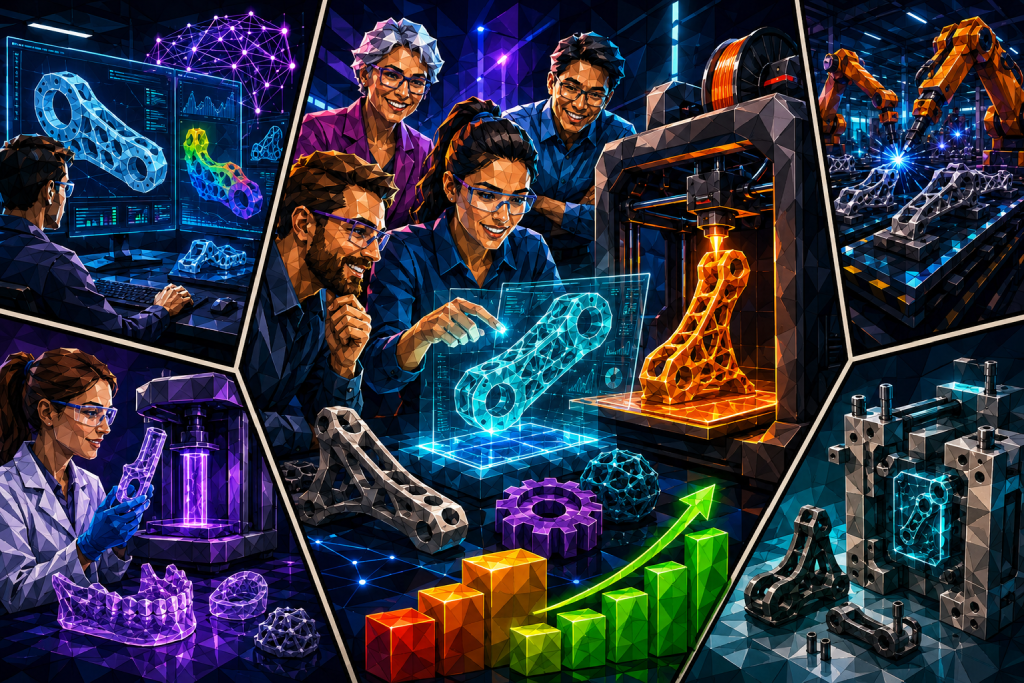
Optimize your design and reduce your costs through strategic CAD modeling and professional material choice
The path from a good idea to a finished product always starts at the computer. Many customers focus solely on the price of the raw material, but your 3D print price is largely determined by the choices you make in the drawing phase. Professional 3D modeling serves as the foundation for the entire production. If you optimize your 3D model correctly from the start, you reduce both machine time and material waste.
[3D print business]
How does your first 3D CAD model affect the final 3D print price?
Your journey toward a physical item starts with Computer-Aided Design, also called CAD. This technology arose over 60 years ago when Ivan Sutherland created the Sketchpad program. Today, we use 3D CAD to give flat 2D sketches volume and thickness (extrusion). The choice of software affects your 3D print price directly. Simple systems like Tinkercad often use geometric shapes (CSG), which limit your ability to optimize the item for production. When you choose professional software, you get access to tools that make the item lighter and stronger. This choice lowers your 3D print price because your 3D printer must use less material and shorter 3D print time. You should therefore regard the choice of software as a direct investment in a lower production price.
[Get your 3D print price now]
Why is precision in 3D modeling your most important source of savings?
You should always measure your items with extreme precision before you send the file to us. Small errors in the placement of holes or logos often make the item useless. If your 3D model is skewed or lacks concentric circles, we must run the process again. A typical test figure like a Benchy weighs 12 grams and costs around 20 INR in pure material. But with power, maintenance, and working time, the real price rises to over 135 INR. If we have to restart a faulty 3D print, you double these costs immediately. You should therefore spend time on precise measurements in your 3D model to avoid unnecessary waste of both material and 3D print time. Precision is the cheapest insurance against a high 3D print price.
Which advantages does parametric design provide for your total 3D print price?
Parametric design in software like SolidWorks creates a logical connection between all parts of your 3D model. If you change the size of the base of your item, the rest of the geometry follows automatically. This method saves many hours in the development phase. When we need to optimize your 3D print price, parametric models make it possible to fix errors or adjust tolerances in minutes. This means you get from prototype to final production faster. You should choose parametric design if your product requires several iterations, as it minimizes the time we must spend on manual file handling and adjustment of the 3D print itself.
How do you optimize the geometry in your 3D model to lower machine costs?
You should look at your 3D model with critical eyes to remove redundant material. However, you should be careful about making the geometry too complex without reason. A cube with too many small holes can actually increase your 3D print price because it forces your 3D printer to perform many small movements, increasing your 3D print time. You should also incorporate rounded edges (fillets) in the drawing itself. If you omit these, we might have to post-process the item manually with tools, which increases your total price. Smart adjustments in your slicer setup, such as choosing strong walls rather than 20 percent standard infill (fill), often reduce the price without weakening the item.
Why should you choose professional 3D modeling for industrial serial production?
When your production grows from individual items to series of over 10,000 pieces, the economic rules of the game change significantly. Here, your 3D model becomes the foundation for injection molding. A professional steel mold requires an investment ranging from 300,000 INR to 3,000,000 INR. You should therefore test your model with a resin 3D print (SLA) first. Resin uses light-sensitive liquid and UV light to create items with extremely fine details and thin walls without visible layer lines. This step ensures that your fit is perfect before you purchase an expensive mold. For large quantities, the unit price drops drastically because the raw material for injection molding is cheaper than filament for a 3D printer. Professional 3D modeling ensures that your item complies with all technical requirements such as draft angles, so the item can leave the mold without damage.
Why is Computer-Aided Manufacturing (CAM) relevant for your 3D print price?
CAM functions as the bridge between your digital drawing and the physical production. The software translates your 3D model into G-code, which are the specific instructions for your 3D printer. Professional integration between CAD and CAM removes uncertainty in production. When we use systems with built-in CAM, we can simulate the process and discover errors before we start your 3D printer. This preparation ensures stable production and keeps your 3D print price down because we eliminate failed attempts and optimize the utilization of the machine. The G-code instructions dictate every movement, and an optimized code saves valuable 3D print time.
Understand the most important terms behind an effective 3D print price
To navigate the process, you should know the technical terms that affect your bill. Infill covers the internal structure of your item, and the choice here has great significance for both strength and 3D print time. Batching is another important method where we run several items simultaneously on your 3D printer to save working time and startup costs. If you are planning a larger production, you should also consider your ROI (Return on Investment). This is the time it takes before an investment in, for example, an injection mold has paid for itself through a lower unit price compared to a standard 3D print.
| Design parameter | Effect on 3D print time | Effect on 3D print price |
| High precision (0.1 mm tolerances) | Increases time moderately | Ensures against expensive reprints |
| Standard 20 percent infill | Normal time | Base cost |
| Optimized walls (low infill) | Reduces time significantly | Lowers the price |
| SLA resin test print | High level of detail | Saves mold costs later |
| Batch production (multiple items) | Reduces startup time | Lowers price per item |
What does it cost to have a 3D model made for 3D print?
The price of a 3D model depends on the complexity of the task and the chosen software like SolidWorks. A simple component can take a few hours, while advanced industrial parts require extensive parametric design. The investment in a professional drawing often pays for itself quickly through reduced material consumption and a shorter 3D print time.
Which drawing program is best for 3D print?
Fusion 360 and SolidWorks are the best choices for professional production and accurate calculation of your 3D print price. These programs support parametric design, which makes it easy to fix errors. For very simple hobby tasks, Tinkercad exists, but it lacks the necessary tools for industrial optimization of the 3D print itself.
How can I make my 3D print cheaper through design?
You should reduce the item’s volume and optimize the wall thickness to lower your 3D print price. By using smart slicer settings and removing unnecessary fill (infill), you can shorten your 3D print time significantly. Always ensure to incorporate draft angles and rounded edges directly into your 3D model to avoid manual post-processing.
Why is precision in measurements so important for the price?
Precision prevents expensive re-prints and waste of material, which directly protects your 3D print price. If holes or threads in your 3D model deviate by just a few millimeters, the physical result often becomes useless. Correct measurements from the start eliminate the need for several iterations and save both power and expensive machine capacity.
When should I switch from 3D print to injection molding?
You should consider injection molding when your production exceeds 1,000 units and your ROI begins to make sense. Although the startup costs for a mold are high, the unit price becomes much lower than with a traditional 3D print. A professional 3D model prepared with the correct draft angles makes the transition from prototype to serial production economically optimal.
Take control of your project and get the best price on your next 3D print
You achieve the best 3D print price by thinking about production as early as the first line of your 3D model. Precision and measurement prevent waste, while parametric design makes your corrections fast and cheap. You should always evaluate whether your item is suitable for agile production on a 3D printer or if you should prepare the design for injection molding for larger volumes. By choosing the right software tools and optimizing your geometry, you control your own costs from idea to reality.
You should contact us early in your design process so that we can together optimize your 3D print time and ensure you the sharpest price on the market. Let us help you turn your vision into reality with the most effective production method.