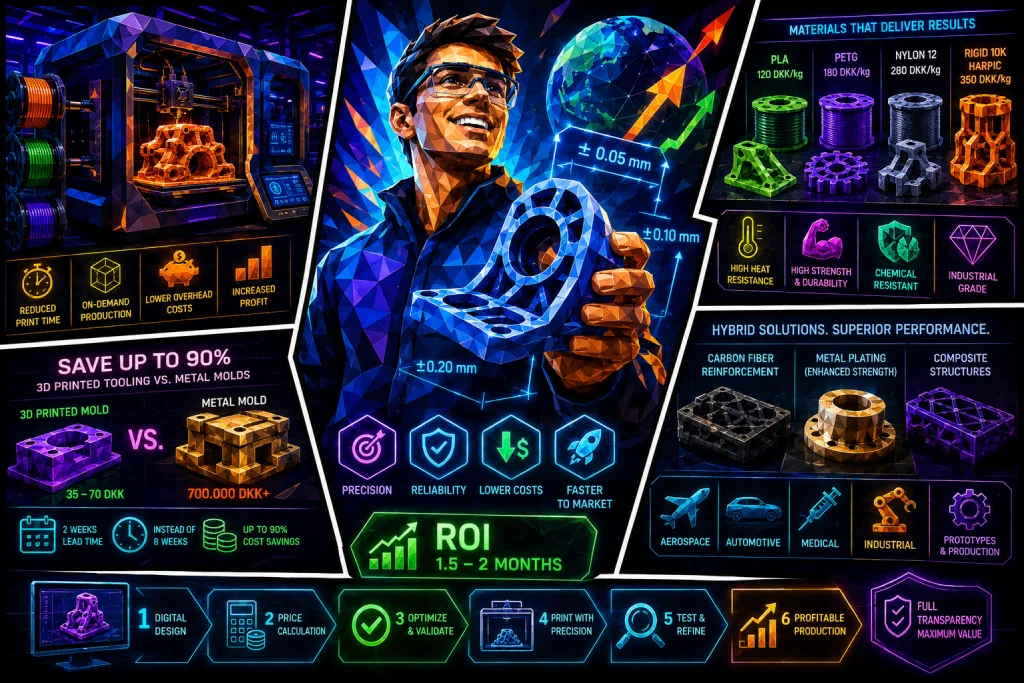
A guide to material selection and economic optimisation of your 3D printer production
The price of raw materials forms the foundation of your budget. Standard plastic such as PLA typically costs around 1,440.00 INR per kg. You should always include shipping costs to know the real price of the material. Industrial tasks often require special materials like Rigid 10K resin. A 3D printed mould in this material often costs between 420.00 INR and 840.00 INR in pure material consumption. You should use the total weight from your G-code to calculate the price precisely. This weight includes both the 3D print itself and the necessary waste material from towers or nozzle cleaning.
[Calculate 3D print price]
Which factors determine the total 3D print price in industrial production?
Several variables affect the final invoice. 3D print time constitutes one of the heaviest items in the accounts. You should therefore calculate the time in fractions of hours. Just 30 minutes extra on a large series has a great impact on your overall economy. Electricity consumption also plays a role. An industrial 3D printer typically uses around 650 watts on average during production. Even though the machine has a higher nominal power, you should calculate with the actual average consumption. You should furthermore always include a failure rate of 10 percent in your calculations. This covers unforeseen waste and ensures against economic surprises.
Why is material selection crucial for success with industrial 3D projects?
The right material ensures your part’s durability in the intended environment. For example, our team has seen how 3D print is used to manufacture prototypes of all components for new vehicle developments. They choose materials based on specific requirements for flexibility and mechanical strength. If you manufacture moulds for injection moulding, you should choose materials with extreme heat resistance. Rigid 10K resists temperatures up to 218 degrees Celsius. This makes it possible to use the mould for production of traditional plastic types without risk of deformation.
How does the price of standard plastic differ from high-performance polymers?
Standard materials keep your startup costs down. However, industrial tasks often require high-performance polymers to achieve the desired result. The price of these materials is higher, but they offer chemical resistance and superior strength. A 3D printer for 1,260,000.00 INR handles these materials far better than cheaper models. You should invest in quality materials for aerospace or medical equipment. The durability in these materials reduces the need for reprints over time. This lowers the total 3D print price in the long run.
Which materials are best for functional prototypes and end products?
The choice of material depends on the mechanical load on the item. You should investigate medical grade materials for products with direct skin contact. For end products, you should prioritise surface finish and the material’s ability to withstand daily wear.
How does the complexity of the design affect your choice of 3D printer and material?
Complex geometries often require support material or 3D printers with dual extrusion. You should optimise your build plate by placing many items at once in your 3D printer. By 3D printing 24 units simultaneously, you exploit the machine’s full capacity. This strategy significantly reduces the total 3D print time per part. A complex design in a stable 3D printer ensures uniform quality throughout your production at our facility.
How much do you save by optimising your 3D model for industrial materials?
Optimisation removes unnecessary expenses for both time and material. Large industrial groups like Unilever and Serioplast reduced their costs by up to 90 percent by switching from metal moulds to 3D printed solutions. They simultaneously cut delivery time from eight weeks to only two weeks. Academic racing teams at TU Berlin achieved a saving of 50,400.00 INR on a steering wheel for their race car. They combined a 3D printed part with carbon fiber instead of using traditional CNC milling in aluminium.
How do you choose between SLA, SLS, and FDM for industrial tasks?
FDM technology is best suited for robust and large items. SLA, on the other hand, delivers extremely smooth surfaces down to 50 microns. This is particularly suitable for precision tools. If you need the most advanced machines, you should expect an investment of over 16,800,000.00 INR for a model like the Markforged FX20. You should choose technology based on your specific requirements for detail and your 3D printer temperature capacity.
How our online 3D print price calculator creates value for your business
Transparency removes uncertainty in your purchasing process. Many suppliers hide their prices, which wastes your valuable time. Our online 3D print price calculator gives you a precise quote immediately. The tool helps you assess your budget of, for example, 240,000.00 INR quickly and effectively. You avoid guesswork and simultaneously gain full insight into factors such as depreciation of your 3D printer and the specific material expenses. A healthy business should aim for a mark-up of around 300 percent. This ensures both profit and the necessary funds for future growth.
When do you achieve a return on your investment in industrial 3D printers?
An industrial 3D printer for 1,260,000.00 INR pays for itself in only 1.5 to 2 months with the right project. You should consider the machine as an asset rather than an expense in your accounts. By producing parts internally, you save money on expensive external suppliers. You simultaneously reduce your storage costs significantly. Your economic return depends on your ability to move relevant tasks from traditional production over to 3D print.
Why should you demand full price transparency from your 3D print partner?
Trust arises through complete honesty about all costs. You should choose a partner like 3D actions that presents prices freely to everyone. An open approach with technical documentation and clear prices shows confidence in the technology. It makes it possible for you to do your own research in peace and quiet. You should always make decisions based on facts rather than hidden sales agendas.
How does Rapid Tooling with 3D printed moulds optimise your production?
Rapid Tooling bridges the gap between your prototype and final mass production. You should use 3D printed moulds for injection moulding or blow moulding of your pilot series. A traditional metal mould often costs 8,400,000.00 INR to manufacture. A 3D printed version costs only a fraction of this price. This method allows you to test your product in the correct end-use materials before making a large investment.
How do hybrid technologies improve your 3D printed parts?
You should consider hybrid solutions to achieve technical properties that plastic alone does not offer. Electroplating coats your 3D print with a layer of metal. This improves both the mechanical strength and the electrical shielding. It simultaneously gives a unique aesthetic finish to the product. By combining 3D printed cores with carbon fiber, you create light and extremely strong components for demanding industries such as aerospace or motorsport.
How do you calculate the price of an industrial 3D print?
You calculate the price by adding material costs, power consumption, depreciation of your 3D printer, and the expected failure rate. A precise calculation requires insight into the total 3D print time and the weight of the item including waste material. By using our online 3D print price calculator, you should get a transparent quote.
Which material is best for industrial 3D print?
The best material depends on your application, but Rigid 10K and Nylon are popular choices for mechanically strong components. Rigid 10K resists temperatures up to 218 degrees Celsius and is suitable for injection moulds. For functional prototypes, you should choose materials with high impact strength. Correct material selection ensures that your 3D print meets the requirements.
How quickly should one expect ROI on an industrial 3D printer?
You should often expect a full return on your investment in an industrial 3D printer in just 1.5 to 2 months. By moving tool production internally, you save large amounts on external suppliers. A machine for 1,260,000.00 INR pays for itself quickly when you significantly reduce your delivery time from weeks to days.
How do you choose between FDM and SLA for industrial tasks?
You should choose FDM for large and robust items, while SLA is the right choice for precision parts with smooth surfaces. FDM technology is ideal for functional testing of larger components. SLA, on the other hand, delivers a detail level of 50 microns. The choice of technology affects both your 3D print time and the final finish of your 3D print.
What are the advantages of Rapid Tooling with 3D printed moulds?
The greatest advantage is a cost reduction of up to 90 percent compared to traditional metal moulds for low-volume production. Rapid Tooling should give you the opportunity to test items in real materials in a few weeks. You achieve enormous flexibility in the design phase and avoid expensive errors. It optimises your development at our facility.
How does the complexity of the design affect the price of a 3D print?
Complex geometries increase the price if they extend your 3D print time or require large amounts of support material during the process. Advanced geometries often require a 3D printer with dual extrusion for a good result. You should optimise your 3D model to minimise material consumption. A well-thought-out model ensures faster production and a lower price.
Make your next industrial production profitable with the right 3D print strategy
Industrial 3D print requires precise planning and a deep understanding of the economy behind the processes. You should look beyond the price of the 3D printer itself. You should instead assess the total operating costs such as 3D print time and the expected failure rate. Choose materials like Rigid 10K for tooling tasks to ensure the necessary heat resistance in production. You should always use a transparent 3D print price calculator to protect your project against unforeseen losses. With the right strategy, you achieve a fast return and a far more flexible production.
Contact us today to hear more about your options with 3D actions.