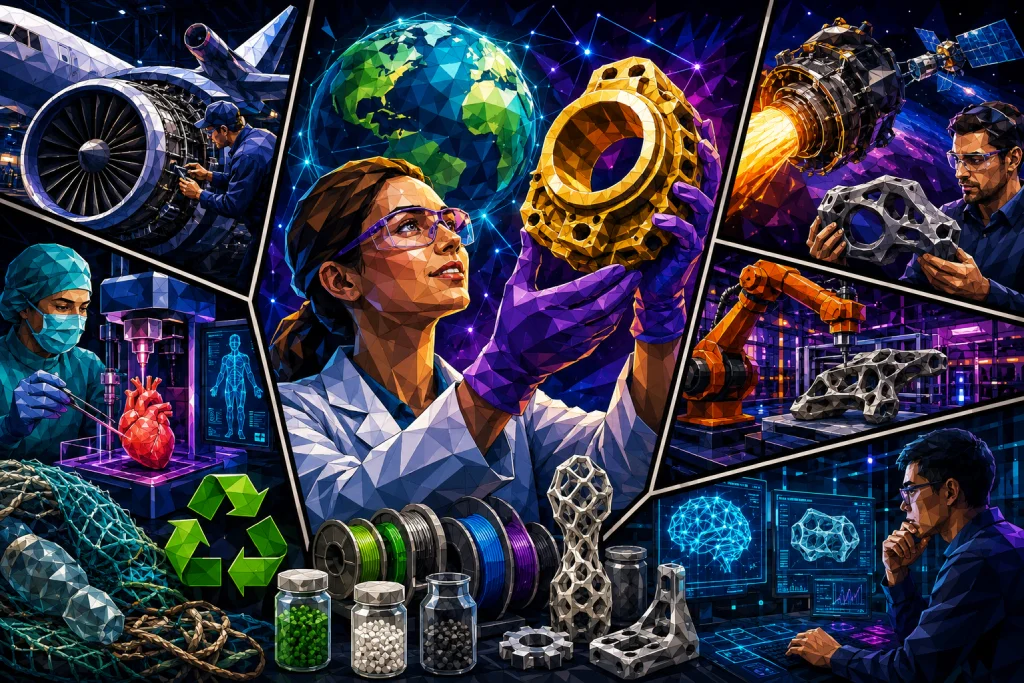
From advanced polymers to bioprinting and intelligent 3D actions in modern production
Materials are now driving the development of 3D print and fundamentally changing the way companies design and manufacture products. Bio-based plastics, recycled filaments, advanced metal alloys, and self-repairing polymers (plastic materials consisting of long molecular chains) create new opportunities in industrial production and medical solutions. Today, leading manufacturers produce aircraft components, medical implants, and living tissue with 3D print. This technology now directly challenges conventional production methods and demands deep technical understanding.
Artificial intelligence and machine learning optimize the precision in every 3D print process. Simultaneously, multi-material 3D print combines different properties in one 3D print itself. Sustainable materials reduce resource consumption and ensure local production. Companies should create products exactly as needed to eliminate overproduction and waste in their supply chain.
[Get 3D print price]
Why are advanced materials changing the foundation of 3D print?
3D print is now changing the way we design, manufacture, and use products in everyday life. The technology is reshaping sectors such as aerospace, medicine, and consumer goods. The materials used in the 3D print itself constitute the most important factor behind this development.
The first 3D printers primarily worked with simple plastic. Now, manufacturers have expanded the repertoire significantly. Today, you should use metals, ceramic materials, nanocomposites (materials reinforced with microscopic particles), or biological tissue for advanced tasks. This development enables the manufacture of lightweight components for aircraft, individually tailored medical implants, and sustainable building materials. Material technology constantly pushes the boundaries for the results in your 3D printer.
Which opportunities do high-performance polymers like PEEK and PEKK provide in the industry?
The industry today requires stronger, more temperature-resistant, and precise polymers. Polyetheretherketone (PEEK) and Polyetherketoneketone (PEKK) represent advanced thermoplastic (plastic that becomes soft when heated) materials for medical technology and aerospace. PEEK maintains its mechanical strength at temperatures up to 260°C and resists chemical influences.
These properties make the materials ideal for implants, aircraft engines, and equipment for the oil industry. Extreme conditions place high demands on material durability. The development of composite materials, where manufacturers reinforce plastic with glass or carbon fiber, also opens new doors. These hybrid materials combine low weight with high strength. The automotive industry, aerospace, and robotics should utilize these materials for their production. Airbus and BMW are already reducing the weight of components with composite-reinforced polymers without weakening durability.
How are metal materials revolutionizing production in aerospace and medicine?
Metals play a decisive role in 3D print for aerospace, the healthcare sector, and energy production. Titanium constitutes one of the most used metals due to low weight, high strength, and biocompatibility (material that works with living tissue). Surgeons use titanium for hip implants and dental prosthetics because the body accepts the material without risk of rejection.
Technologies like Selective Laser Sintering (SLS) and Electron Beam Melting (EBM) produce precise metal parts with high structural integrity. Boeing and Airbus use these methods to develop lightweight aircraft components that lower fuel consumption. Boeing’s Dreamliner 787 flies today with over 300 different 3D printed titanium parts. This saves weight and streamlines the overall production processes.
GE Additive and NASA are now testing nickel-based superalloys like GRX-810. These materials withstand temperatures of over 1093°C in jet engines and spacecraft. Copper alloys with high electrical conductivity also improve cooling systems in electric cars and computers.
What is the significance of sustainable and recycled filaments for the future of 3D print?
Sustainable materials lower waste volume and CO₂ emissions from production. PLA (Polylactic Acid) originates from corn starch or sugarcane and replaces oil-based plastic as an environmentally friendly alternative. Recycling is also gaining ground in the industry. Manufacturers are now creating filaments from recycled fishing nets from the North Atlantic, plastic bottles, and industrial waste. The Netherlands and Norway lead this development in material recycling.
The construction industry uses large robot-controlled 3D printers with recycled concrete and bio-based polymers for houses and bridges. Building projects in Dubai and Shanghai now show how 3D print minimizes material waste in construction. Researchers at the University of California manufacture bioplastics from seaweed as a replacement for traditional plastic. Sustainable materials make 3D print a central part of an environmentally friendly future.
Why are flexible materials like TPU crucial for custom solutions?
Flexible materials enable the production of items with both elasticity and mechanical strength. Thermoplastic Polyurethane (TPU) combines high wear resistance with flexibility for sports equipment and industrial seals. Adidas uses 3D printed TPU in the soles of Futurecraft 4D running shoes. A specially designed lattice structure optimizes shock absorption for the runner.
In medicine, silicone-based materials have changed the manufacturing of soft prosthetics and orthopedic aids. Mayo Clinic and Stanford University in the USA use hyperrealistic training models where 3D printed silicone organs react like real human tissue. Soft robotics also uses flexible materials for grippers that handle fragile objects in the food industry without destroying them.
What are the advantages of combining several materials in the 3D print itself?
Multi-material 3D print integrates rigid, flexible, and conductive materials in one workflow. You thus eliminate the need for subsequent assembly of components. MIT’s Mediated Matter Group designs tailored prosthetics that mimic the skin’s texture and elasticity through this method.
The electronics industry uses the technology to 3D print circuits directly into plastic components. Researchers from Harvard University and the University of Illinois manufacture components with integrated sensors in a single process. Duke University is also developing 3D printed batteries for drones and medical implants. This technology removes the limitations of traditional manufacturing methods.
How can on-demand production and micro-factories optimize the company’s resources?
3D print makes it possible for your company to produce components locally and as needed. You should use on-demand (production that only starts upon order) manufacturing to minimize material waste and optimize inventory management. Micro-factories in cities like Amsterdam, Tokyo, and Berlin use 3D printers close to the end user. The startup CEAD in the Netherlands operates a network of large-format 3D printers for furniture and industrial equipment.
Decentralized production makes your business model more agile. Hospitals can now 3D print medical devices directly in the operating room. During crises, local actors quickly manufacture protective equipment with 3D print. On-demand production in local micro-factories adapts manufacturing to customer needs and ensures success through speed. By implementing smart 3D actions, you reduce both transport time and overall resource consumption.
How do artificial intelligence and machine learning optimize the 3D print process itself?
Artificial intelligence drives the 3D print of the future by adjusting settings in real time. AI identifies errors along the way and optimizes the layer buildup to eliminate material waste. NVIDIA and MIT’s Self-Assembly Lab are developing 3D printers that change the material structure dynamically during the 3D print itself. This enables self-repairing surfaces and adaptive components that react to humidity or heat.
Algorithms generate complex geometric shapes that no human can design manually. The aerospace industry saves weight and fuel with these AI-optimized designs. Airbus and NASA are already using AI-generated lightweight structures that maximize strength with minimal material consumption. AI reduces your 3D print time and significantly raises quality.
Which breakthroughs can we expect from nanocomposites and bioprinting in the future?
Research in 3D print materials is currently changing industry, medicine, and aerospace. Nanocomposites improve the mechanical and electrical properties of polymers and metals. Researchers at the Fraunhofer Institute in Germany have developed carbon-nanotube-reinforced polymers. These materials are 50% stronger and 30% lighter than traditional plastic. The automotive industry and robotics should implement these improvements as soon as possible.
Bioprinting (3D print with living cells for biological tissue) is already taking place in medical laboratories. The Wake Forest Institute for Regenerative Medicine in the USA is working on 3D printing functional tissues for the human body. In the long term, bioprinting may eliminate the need for donated organs in countries like Japan and the Netherlands. 3D print is now about creating intelligent and self-repairing materials for the future.
Comparison of advanced 3D print materials
| Name | Primary property | Temperature resistance | Typical region |
| PLA | Bio-based and degradable | 60°C | Global – Denmark |
| PEEK | High strength and chemical resistance | 260°C | USA – Germany |
| Titanium | Lightweight and biocompatible | 1600°C | Global – Aerospace |
| TPU | Flexibility and wear resistance | 80°C | USA – Germany |
| Nanocomposites | Reinforced strength and conductivity | Varying | Germany – Japan |
When should a company choose 3D print over traditional injection molding?
Companies should evaluate their production needs thoroughly before choosing a method. Injection molding often requires the manufacture of molds, which takes a long time and requires many resources at startup. 3D print eliminates these tooling requirements entirely. For smaller series up to 10,000 items, you should choose 3D print to achieve the fastest delivery and greatest flexibility. 3D print also allows for design changes without extra resource requirements, which injection molding does not. You should use the technology to test and validate your items before any potential large-scale production.
Are 3D print materials sustainable for the environment?
The sustainability of 3D print depends on the choice of bio-based filaments like PLA or recycled materials from ocean plastic and fishing nets. You should choose recycled polymers to reduce your company’s overall CO₂ footprint. This approach supports a circular economy and reduces general material waste in every single 3D print process in the future.
Can 3D printed plastic replace traditional metal components?
High-performance polymers like PEEK and PEKK are currently replacing metal components in both aerospace and medical equipment due to their extreme strength. You should implement these materials to achieve a weight saving of up to 60%. This improves product performance and makes the 3D print itself more resistant to chemicals.
How does artificial intelligence affect the quality of a 3D print?
Artificial intelligence optimizes the layer buildup and adjusts the settings in your 3D printer in real time to minimize errors and waste. AI algorithms shorten your 3D print time significantly by finding the most efficient paths for the print head. Companies should use AI-generated designs to maximize the strength of their finished industrial components.
Which metal materials should be used for industrial 3D prints?
Titanium and nickel-based superalloys constitute the most important metal materials for industrial tasks requiring high biocompatibility or extreme heat resistance. You should use titanium for medical implants and lightweight aircraft parts. These metals ensure high structural integrity in every single 3D print and significantly extend the lifespan of components in modern production.
Why should companies choose local on-demand production?
Local on-demand production eliminates the need for large warehouses and reduces transport time through the use of micro-factories close to the customer. You should utilize this model to make your supply chain more agile and robust. This strategy saves many resources and allows your company to perform rapid 3D actions.
What is bioprinting and how is it used in medicine?
Bioprinting uses living cells as a material to create functional biological tissue and potentially future organs for transplantation. Researchers should use this technology to develop tailored medical solutions. The method revolutionizes regenerative medicine and reduces the need for donated organs through precise 3D prints of complex and living cellular structures.
Optimize your production with future 3D print technologies
The development of new materials creates stronger and lighter components for the industry. By implementing high-performance polymers and advanced metal alloys, your company can solve complex tasks that were previously impossible. Simultaneously, sustainable materials and recycling ensure that production meets future environmental requirements.
Local on-demand production in micro-factories and the use of intelligent 3D actions make your business model more agile and robust against global supply crises. The future of 3D print materials is now redefining how we create and use products in a digital age.
Contact us to hear more about how the latest materials can benefit your next project.