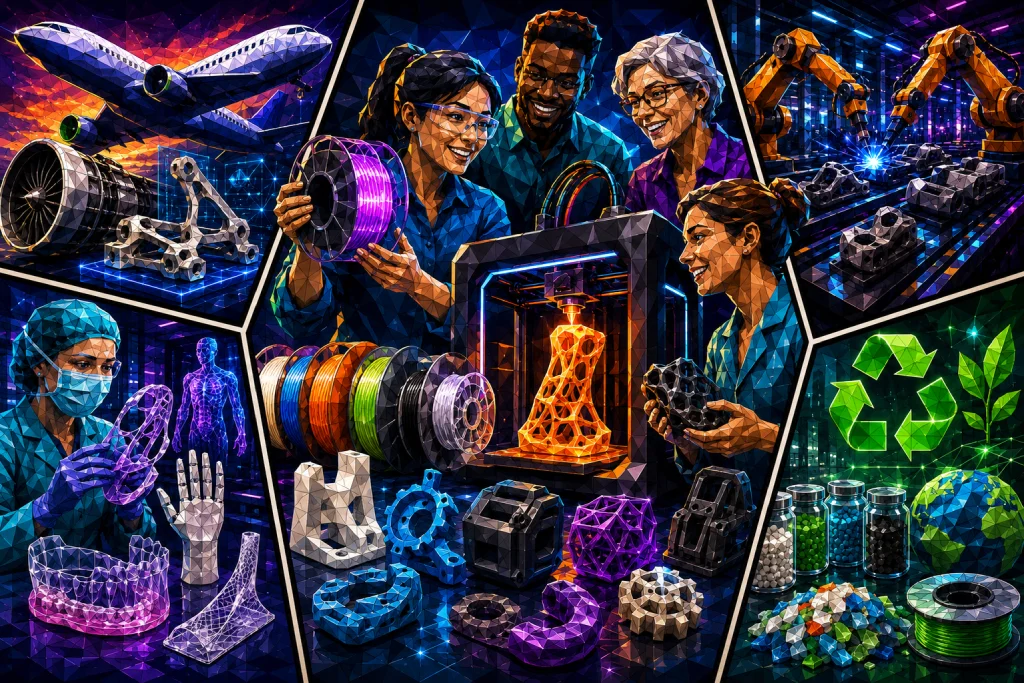
How filament type and price are connected
Price often means a lot when you choose filament for 3D print. Still, many overlook what actually lies behind the price tag. Different filament types vary not only in price but also in durability, strength, and application. At 3dprintingprice.in, we often see people choosing the cheapest material without thinking about how it affects quality. In this article, we review how price and material choice are connected – and why it pays to choose correctly from the start.
What does filament cost generally?
The price of filament for FDM printers varies significantly. PLA is the most widespread material and typically costs between 1,800 and 3,600 INR per kilo. ABS lies slightly higher, often in the range of 2,400 to 4,800 INR. PETG, which is known for being both durable and easy to work with, normally costs between 3,000 and 6,000 INR. TPU and nylon begin around 3,600 INR, but the price rises quickly, especially for high quality. Some types cost over 9,500 INR per kilo. It is not only the material that affects the price – the filament’s consistency, the manufacturer’s reliability, and the amount of errors during print also play a role. Cheap filament can look like a saving, but it often leads to errors and waste, which makes it more expensive in the long run.
PLA – the budget-friendly all-rounder
PLA belongs among the cheapest filament types and is easy to work with, making it suitable for beginners and hobby projects. It places fewer demands on the equipment, as it requires neither a heated build plate nor a closed chamber. The material exists in many colors and finish variants, making it popular for models and prototypes where appearance has high priority. On the other hand, PLA does not withstand high temperatures and quickly becomes brittle, especially under load or long-term use. Therefore, it is less suitable for functional items that must withstand wear or heat. Many choose PLA due to the low price and easy handling, especially when the purpose is visual presentation rather than strength.
ABS – robust, but requires more
ABS was for many years the preferred material for functional 3D print, but many today choose PETG as an easier alternative. On the other hand, ABS provides high strength and withstands temperatures that PLA cannot handle. However, the material requires more from both printer and user. You must use a heated build plate, and many models print best in a closed chamber to prevent warping and cracks in the item. During print, ABS releases fumes, making good ventilation necessary. Compared to PLA, ABS lies slightly higher in price, but it delivers a far stronger construction that can withstand mechanical load and use in more demanding environments.
PETG – middle class with high value
PETG has become a popular choice for functional 3D prints because it combines the strength of ABS with the user-friendliness many associate with PLA. The price lies in the middle class, but the material provides a solid solution for tasks where PLA is not strong enough and where ABS is too demanding. PETG withstands both moisture and chemicals and is therefore well-suited for parts that must endure daily use. It requires some adjustment of printer settings, and many experience small threads between printed items – the so-called stringing effect. Once the printer is correctly set, PETG delivers strong, durable parts with a smooth surface and good dimensional stability.
TPU – flexible but expensive
TPU is a soft and bendable filament that works well for parts that must withstand pressure, twisting, and impact. Many use it for mobile covers, gaskets, and other wear parts where ordinary, hard plastic types do not work. TPU costs more than standard filaments like PLA and requires a printer with direct drive and good filament control. The print speed must be lowered significantly, and incorrect setup often leads to clogging of the nozzle. When the printer is correctly set, TPU delivers strong and flexible items with a long lifespan that few other materials can imitate.
Nylon and other special filaments
Nylon provides high strength and wear resistance and is typically used for functional parts and prototypes in environments with mechanical load. It is well-suited for industrial items but requires a precise printer setup and careful storage, as nylon absorbs moisture from the air. Moisture in the filament degrades layer bonding and leads to weakened prints. You should print nylon at high temperature and lower speed to ensure a stable result. In addition to nylon, there are also special filaments filled with metal, wood, or carbon fiber. These materials cost more and are often chosen for items where the visual expression or special physical properties have high priority – e.g., in design prototypes or visual models with natural structure.
What are you paying for?
Filament prices reflect far more than the raw material itself. Manufacturers who work with tight tolerances in diameter and consistent color mixing deliver filament that runs smoothly through the extruder and minimizes the risk of errors. Good uniformity and precise roundness reduce the number of stops and failed prints. Some filaments are also developed to function stably over time and across different printers and temperature profiles. Although the price is higher, you avoid waste and repeated errors, and it saves both working time and materials. This makes more expensive filament a more effective choice in many projects.
Choose filament based on your project and budget
The right filament depends on the requirements of the task. For visual models and simple prototypes, PLA provides a stable and budget-friendly solution. For parts that must withstand wear, load, or increased temperature, you should choose PETG or ABS. If the item must be bendable or withstand repeated movements, TPU or nylon is more suitable – even if the price is higher. Always choose based on the final result and not just the purchase price. A cheap filament quickly becomes expensive if you have to start over several times. At 3dprintingprice.in, we help you find the right material – whether you print yourself or have us do it. Use the price calculator to get a quick assessment of both price and material.
Find the filament that best matches your need and budget
Filament costs vary – and the price reflects more than just the material. PLA is the cheapest choice and fits fine for hobby projects and models. PETG provides a good balance between price, strength, and print-friendliness and covers the need in most functional prints. ABS and TPU require more experience and the right equipment, but in return, you get high strength or flexibility. Nylon and special filaments are developed for professional solutions where the demands for durability and precision are higher. If you are in doubt about which material you should choose, get in touch with us. We help you find the right filament for your specific task.
What are the advantages and disadvantages of filament types in relation to price?
PLA is the cheapest and easiest, but less durable. PETG offers the most value for money. ABS is strong but requires more. TPU and nylon are expensive but necessary for flexible or professional items. The price often follows quality and function – but not always.
Which filament is best for beginners?
PLA is the best choice for beginners. It is cheap, easy to print with, and does not require advanced equipment. PLA provides stable results and is ideal for models and prototypes where there are no requirements for strength, heat resistance, or flexibility.
What is the difference between PLA and PETG?
PETG is stronger, more flexible, and withstands moisture and heat better than PLA. PLA is easier to print with and cheaper but less durable. Choose PETG for functional parts and PLA for visual models or simple prototypes without high demands for load.
Are more expensive filaments always better?
No, not necessarily. More expensive filaments are often more stable and provide fewer errors, but it depends on your project. For hobby use, PLA is often enough, while professional and functional parts can require materials like PETG, ABS, or nylon to achieve the right strength.
When should I choose TPU instead of PLA?
You should choose TPU if the item must be flexible or shock-absorbing. TPU is used for parts like mobile covers or gaskets where PLA cannot bend or withstand movement. It is more expensive and requires more experience but is necessary for flexible solutions.
Which filament is best suited for functional parts?
PETG is often the best choice for functional parts. It combines good strength, flexibility, and chemical resistance. ABS is stronger but harder to print. Nylon is best for professional use, while PLA is primarily used for visual and non-loaded items.
Can cheap filament affect the print quality?
Yes, cheaper filament can give more errors and poorer surface finish. Uneven diameter, impurities, and poor color stability can lead to clogs or weak layer bindings. It can pay off to invest in better filament to avoid waste and frustration.