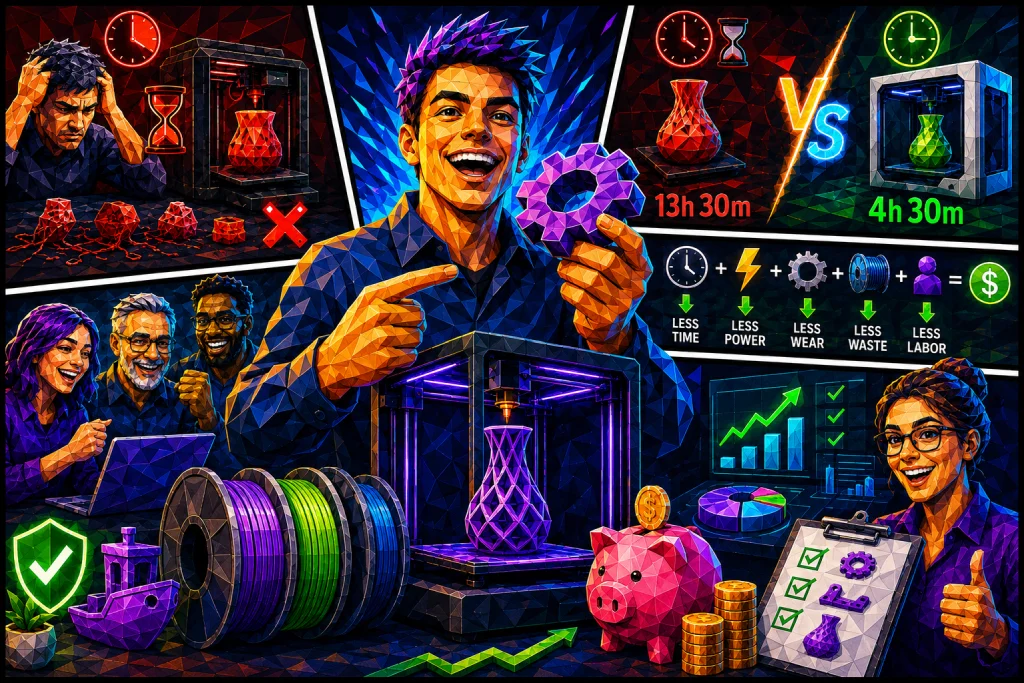
Modern 3D printer technology and optimized workflow ensure you the sharpest 3D print price on the market through reduced machine time
Why is 3D print time the most decisive factor for your 3D print price?
Machine time constitutes the largest part of your total bill because a 3D printer occupies physical space, uses electricity, and requires constant monitoring throughout the entire process. The market for 3D print has changed radically and today functions as a pure speed game. If a specific task takes 13 hours and 30 minutes on an older 3D printer, you as a customer pay for all those hours. By using modern 3D printer technology, we cut many hours off the production itself. A reduction in 3D print time of just three hours per part noticeably lowers your 3D print price.
You should therefore always choose a supplier that prioritizes fast machines to minimize your costs.
[3D print business]
How does modern 3D printer technology change the rules of the market?
Modern 3D printers today use advanced firmware like Klipper to control all movements with extreme precision. Old machines often run at a speed that makes the 3D print unnecessarily expensive and slow. Klipper moves heavy calculations away from the machine’s mainboard, which means we run three times faster than the standard without losing detail. You get your product delivered faster, and we keep the price down. Electricity consumption also drops per part since your 3D printer runs for a shorter time. This makes a direct and noticeable difference to your total 3D print price every single time.
How much do you save by optimizing the 3D print for high speed?
Optimization is about both high speed and technical stability in the process. We use magnetic build plates and advanced PEI sheets to ensure that all parts stay firmly attached during the process. This drastically minimizes the failure rate. In the 3D print industry, one should always expect a failure rate of less than 10 percent to maintain healthy economics. If a machine fails after 10 hours of 3D print time, your 3D print price increases immediately. We eliminate this risk by exclusively using reliable equipment. An efficient 3D print time of 4.5 hours at our facility easily replaces 13.5 hours on a standard 3D printer, placing your 3D print price at the absolute lowest end of the scale.
What significance do hardware upgrades like direct drive and all-metal hotends have for your 3D print price?
Quality components ensure stable operation without unforeseen interruptions. An all-metal hotend makes it possible to perform 3D print tasks at temperatures over 250°C, which is necessary for technical materials like ABS and PETG. Cheap machines with plastic parts often break or melt at those temperatures, and stops in production increase your 3D print price immediately. Direct drive simultaneously ensures that we control the material with millimeter precision. This gives you a stronger 3D print and fewer discarded parts in the trash. You should only trust hardware built for professional use and high temperatures.
What role do Bambu Lab and Klipper play for your total 3D print price?
At 3D actions, we primarily use Bambu Lab machines because they deliver extremely high speed directly from the factory. Industry experience shows that modern hardware makes old machines, such as an Ender 3, completely obsolete. A modern 3D printer costing around 42,000 INR prints three times faster than older models. We let the machines work in an intelligent network, which reduces the need for manual and expensive labor. The saved labor time is passed directly to you as a lower 3D print price. We utilize the latest technology to make professional production accessible for all types of tasks.
Why have older 3D printers become an economic dead end?
Older 3D printers require constant and expensive upgrades just to keep up with current developments. If you have to spend 12,000 INR on new spare parts for a machine that only costs twice that, you are losing money from day one. Their slow movements mean that your 3D print time per part becomes far too high. This makes your 3D print price disproportionately expensive compared to the modern alternatives we offer. We have consciously phased out slow hardware to ensure that you do not pay for outdated technology. Modern machines have an expected lifespan of 10,000 hours, and we spread this cost over many thousands of parts to keep your price down.
Is there a connection between high 3D print speed and part quality?
High speed always requires precise and stable temperature control. When we perform a 3D print task quickly, we must be able to melt the plastic faster and more evenly than normal. Our all-metal hotends handle this task without problems or clogs. In traditional injection molding, the material is completely homogeneous, and we strive for the same strength in our 3D print through optimized settings. By controlling the layer height and temperature precisely, we ensure that the part does not separate under physical stress. You receive a strong and durable product, even though we drastically reduce the 3D print time through technological superiority.
How do you calculate the hidden costs behind a professional 3D print price?
A correct and transparent 3D print price contains much more than just the price of the plastic. We factor in the actual electricity consumption based on the current price per kWh. We also include amortization, which covers the machine’s ongoing depreciation and maintenance. Every minute a 3D printer runs, the mechanical components experience wear and tear. If a machine runs 20 hours a day, that production must contribute to its own future replacement. We also include a markup to cover taxes, fees, and handling. You should know these factors to understand why speed is the absolute most important lever to pull if you want to save money on your project.
How can you optimize your files yourself to get an even lower 3D print price?
You should always design your parts with the production itself in mind, which is known in the industry as Design for Manufacturing. Small strategic changes in geometry can often eliminate the need for support structures entirely. Support structures increase both your 3D print time and your total material consumption without adding value to the final product. You should also always try to fill the build plate completely in your planning. If we can perform a 3D print of nine parts at once, we distribute the setup time and reduce the idle time that occurs during color changes or preparation. A full build plate is the fastest way to a cheap 3D print price. You should always ask our team for advice on design optimization before placing your final order.
When is 3D print cheaper than traditional injection molding?
Injection molding always requires very expensive molds made of steel or aluminum. Such a mold often costs between 2,800,000 INR and 8,400,000 INR in startup costs. You therefore need many thousands of parts before the large investment pays for itself. 3D print has no startup costs for tools or molds. This makes 3D print the cheapest option for series up to several thousand pieces, depending on the size of the part. By using our fast 3D printers, we move the boundary for when it pays off for you to switch to traditional molding. You should choose 3D print if you want to maintain the ability to change your design quickly and continuously without economic risk.
What is the average 3D print cost per part?
Your 3D print price depends primarily on material consumption, the complexity of the part, and the total 3D print time in the machine. A professional 3D printer with high speed can produce parts cheaper than older hardware. We always calculate the price based on efficient machine time combined with the current prices for electricity and plastic.
When is 3D print cheaper than injection molding?
3D print is cheapest for small and medium-sized series because you completely avoid the high startup costs for molds. A mold can cost between 2,800,000 INR and 8,400,000 INR, which requires enormous volumes to achieve ROI. With a fast 3D printer, you get high agility and low prices instead.
How can I reduce my 3D print price myself?
You should optimize your design for production by removing unnecessary support structures and ensuring a uniform wall thickness in your files. By reducing the expected 3D print time through clever design, your price drops immediately. You should also consider ordering multiple parts at once to fill the build plate completely.
What significance does material choice have for the price?
Material choice affects your 3D print price through the raw material cost and the requirements the plastic places on your 3D printer and hotend. Technical materials like ABS require higher temperatures and often longer 3D print time to ensure optimal layer strength. You should choose the material that exactly matches your need for strength and durability.
Does high speed result in a lower quality 3D print?
No, high speed in a modern 3D printer with Klipper firmware maintains high quality through precise acceleration control. By using an all-metal hotend, we ensure that the plastic melts evenly even at a high tempo. You therefore get a strong and precise result, even though we reduce the actual 3D print time.
Why is electricity consumption relevant to my price?
Electricity consumption is included as a fixed part of the calculation for your 3D print price, as the machine runs for many hours. A fast 3D printer uses electricity for a shorter duration per part, making production more energy-efficient and cheaper. We use current electricity prices per kWh to provide you with a fair price.
Get the best 3D print price through a technological head start
The connection between 3D print time and your final price is unavoidable. By choosing a partner like 3D actions, who invests heavily in fast technology such as Bambu Lab and Klipper firmware, you ensure the lowest costs on the market. We significantly reduce machine time and pass the savings directly on to you. We factor in all technical parameters such as electricity, maintenance, and depreciation, so you get a transparent and fair 3D print price every time. You should utilize our optimized workflow and extensive experience for your next projects to achieve the best result at the sharpest price.
Contact us today to hear how we can take action to optimize your production and bring your ideas to life quickly and affordably.