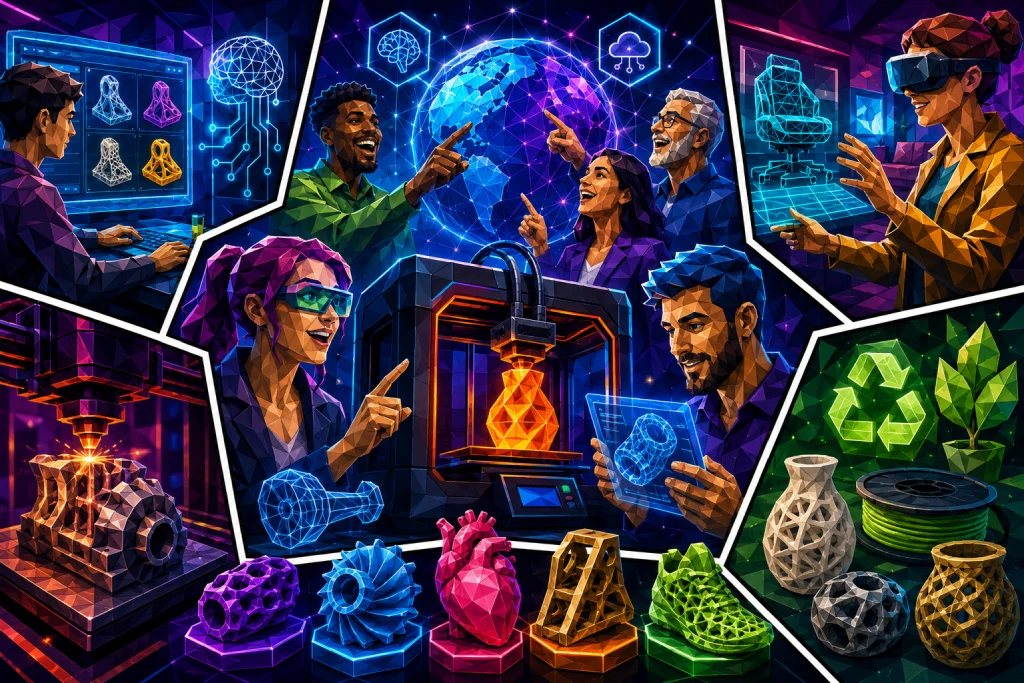
What are the latest trends in 3D print technology?
3D print technology has developed rapidly in recent years, and in 2026, we see a continued acceleration of this development. From the first experiments with plastic and metal print to more advanced applications in industry, 3D print has changed how we design, manufacture, and use products. It is no longer just a tool for engineers and designers – 3D print has become a natural part of our daily lives. This year, we are witnessing some of the most exciting and innovative trends that have the potential to significantly change both design processes and production methods.
There is an increased focus on design possibilities in 3D print, which now include a wide range of materials such as bioplastics, metal, and flexible materials. At the same time, sustainability and recyclability have become central elements, driving demand for more environmentally friendly 3D printed products. Designers are also beginning to integrate technologies like AI and AR/VR to create more dynamic and precise designs that can be adapted to specific needs.
How can AI revolutionize 3D design and print?
Artificial Intelligence (AI) plays an ever-increasing role in 3D design and print. Previously, AI was primarily an assistant that helped fine-tune designs and automate routine tasks. In 2026, AI plays a far more central role in the entire design and 3D print process. AI helps designers optimize models, predict results, and adjust print parameters in real time, which saves both time and money.
AI gives designers the opportunity to quickly create more complex and precise models. Generative design software, which uses AI to create several design alternatives based on defined parameters, opens up new design possibilities. This means that designers can now create models that were previously both time-consuming and impossible to produce.
A good example of AI in 3D design is the integration of software that uses AI to analyze design patterns and make adjustments during the print process. AI ensures that materials are used effectively and that the print quality remains high, even when designs become more complex.
What is real-time collaboration in 3D design?
Collaboration has become essential in modern 3D design. Real-time collaboration tools make it possible for designers and teams to collaborate effectively, regardless of their location. Tools like Autodesk BIM 360 and NVIDIA Omniverse allow teams to share and edit 3D models simultaneously, improving both productivity and creativity. This collaboration allows designers to give feedback quickly, make real-time adjustments, and work on the same files at once, resulting in faster decision-making.
Small businesses are also utilizing these tools, giving them the opportunity to work at the same level as larger companies. Digital twins and virtual prototypes allow small businesses to conduct market research and refine designs before production begins. This has democratized innovation and gives small businesses the same opportunities as the big players.
How do AR and VR play a role in 3D print?
Augmented Reality (AR) and Virtual Reality (VR) are two technologies transforming 3D design and print. By combining these technologies with 3D print, designers can create more engaging experiences and give both customers and partners a better understanding of how a design will look in the real world.
AR is increasingly used to visualize 3D models in the real world. This gives designers the chance to understand how a product will interact with the physical environment, which helps in refining the design. VR allows both designers and customers to step into a virtual environment and experience the product before it is produced. This enables rapid feedback on the design, which improves decision-making.
AR and VR have especially gained attention within retail and architecture, where the technologies are used to create virtual models of products and buildings. Customers can experience products in a 3D reality, helping them make informed decisions about purchases and design adjustments.
Which new materials and technologies are relevant for 3D print?
3D print is no longer just for plastic – today, there is a wide selection of materials that give designers more opportunities to create both functional and aesthetic products. The demand for new elements that simulate metals like steel and brass has increased, and advanced plastic materials enable greater flexibility and durability, opening new application possibilities in the industry.
At the same time, new 3D printers have emerged that can work with flexible materials like rubber and TPU (Thermoplastic Polyurethane), making it possible to produce elastic parts. Technologies like Selective Laser Sintering (SLS) and Multi Jet Fusion (MJF) provide increased precision and enable work with complicated geometric shapes that previously would have been too expensive or technically challenging to manufacture.
Sustainability has become an increasingly important factor in 3D print. The use of bioplastics and alternative materials like hemp and algae has become more popular, and these materials are used in both prototypes and finished products.
How does 3D print technology make everyday life easier?
One of the biggest advantages of 3D print is that it makes it possible to manufacture products quickly and cost-effectively. This ability is especially important for small businesses that do not necessarily have the resources required to develop physical prototypes. Instead, 3D print can be used to quickly create precise models, making it possible for companies to adapt their products to customers’ needs quickly.
3D print also makes it possible to produce tailored products, from customized medical implants to car parts and home interior design. Furthermore, the speed and flexibility of the technology have opened the doors for more economical solutions that are available to both small and large businesses.
The technology has also made it possible to develop more sustainable products. With a focus on materials that are easy to repair and recycle, we see a shift toward products that are not only functional but also long-lasting and environmentally friendly.
What are the latest trends in 3D print technology?
The latest trends in 3D print technology include increased integration of AI, real-time collaboration, AR/VR technologies, and new materials like bioplastics and metal. These trends make 3D print more efficient, versatile, and sustainable, allowing both small and large companies to create innovative products.
Which role do AR and VR play in 3D design?
AR and VR make it possible to visualize and interact with 3D models in the real world or virtual environments. Designers and customers can gain a better understanding of how a product will look before it is produced, improving decision-making and the feedback process.
Which materials are used in modern 3D print?
Modern 3D print uses a wide range of materials, including advanced plastic types, metal powder, flexible materials like TPU, and bioplastics. New filaments like hemp and algae are also gaining ground as sustainable alternatives, making 3D print both functional and environmentally friendly.
How does 3D print technology make production more cost-effective?
3D print reduces costs for prototypes and small series, allowing companies to create precise models quickly and economically. It saves time by eliminating the need for expensive, traditional production methods and makes it easier to tailor products according to customer needs.
How does 3D print promote sustainability?
3D print promotes sustainability by using recyclable materials and reducing waste. The technology makes it possible to manufacture products with less material, which reduces waste. Furthermore, more companies are working on using bioplastics and alternative, environmentally friendly materials in their 3D printed products.
How do Gen Z and Gen Alpha affect 3D design trends?
Gen Z and Gen Alpha, with their preferences for colorful and maximalist design, strongly influence the trends being shaped in 3D design. Their focus on sustainability and innovative solutions drives demand for products that are both aesthetically pleasing and environmentally friendly.
Summary of the latest trends in 3D print technology
As we have seen, 3D print is developing rapidly. AI, real-time collaboration, AR/VR integration, and new materials are driving this development forward. 3D print is becoming more accessible, efficient, and versatile, giving both large and small companies the opportunity to utilize the technology to create innovative and sustainable products.
There is also an increased focus on sustainability and recycling in 3D print. Gen Z and Gen Alpha play a major role in shaping design trends with a focus on colorful design and sustainability. It is clear that 3D print remains a key factor in the future of design and production.