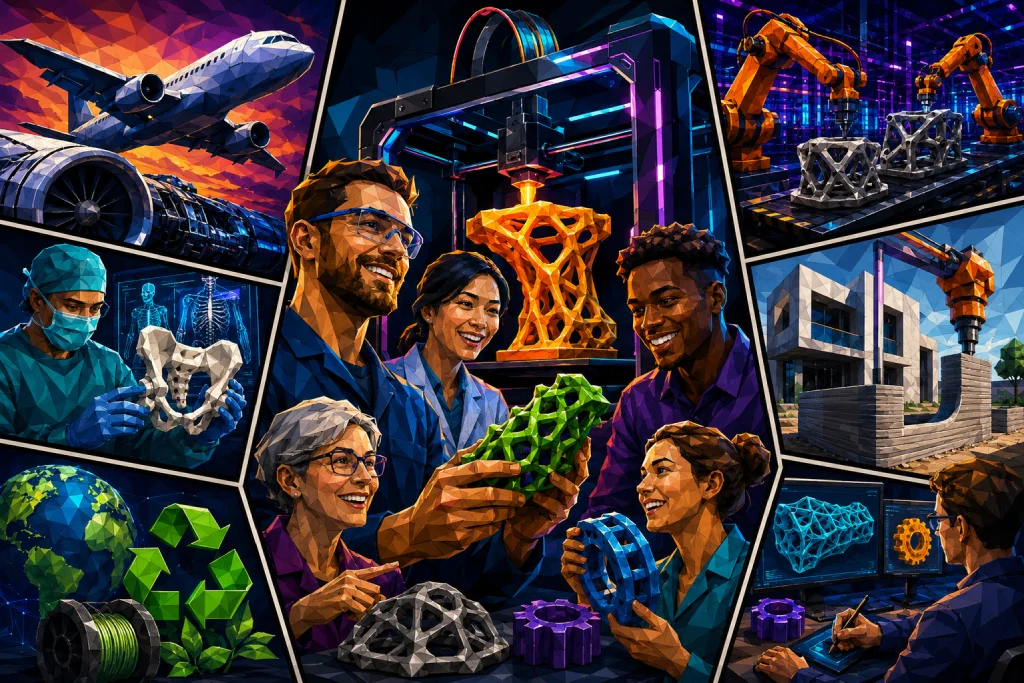
3D print: From niche innovation to industrial revolution
Imagine a future where products are manufactured exactly as needed, without waste or delays. 3D print is no longer an experimental technology limited to prototypes – it is reshaping the production sector across industries such as aerospace, medical technology, the automotive industry, and the construction industry.
Development has been significant in recent years. What began as a method for rapid prototyping is now a central part of industrial production lines. As new materials, faster printing methods, and artificial intelligence are integrated into the technology, companies gain unprecedented freedom to design and produce complex components, tailored solutions, and even mass-produced goods.
This article provides insight into how 3D print is already being used in the industry, what advantages and challenges the technology entails, and how future innovations will shape the next stage of the production sector’s development.
How 3D print is already transforming the industry
3D print is no longer limited to laboratories and development departments. The technology now plays a central role in industrial productions and enables more efficient, tailored, and sustainable manufacturing methods. Several sectors have already integrated 3D print into their production processes, resulting in lighter, stronger, and more advanced components.
Aerospace: Lighter and more efficient components
The aerospace industry was among the first to embrace 3D print, as weight reduction is crucial for fuel efficiency and performance. Companies like General Electric (GE), Airbus, and Boeing use 3D print to manufacture light but strong components that reduce weight and improve engine lifespan.
An example is GE’s fuel nozzle for the LEAP aircraft engine, which is 25% lighter and five times stronger than previous versions produced with traditional manufacturing methods. This component is manufactured as one continuous unit, eliminating the need for assemblies and thus reducing the risk of mechanical failure.
Medical industry: Patient-tailored implants and prosthetics
3D print has revolutionized the healthcare sector by enabling the manufacture of patient-tailored implants, prosthetics, and surgical tools. The greatest advantage is that each unit can be designed precisely to the patient’s anatomy, improving fit, comfort, and functionality.
An example is 3D printed hip implants and dental prosthetics, which can be manufactured based on CT scans to ensure a perfect fit. Within orthopedic surgery, 3D print is used to create surgical guides that help doctors perform precise operations, reducing both operation time and recovery period.
Construction: Faster and more sustainable structures
3D printed buildings have received increasing attention as a faster and more sustainable building method. By using concrete, bio-based materials, and recycled materials, the construction industry can reduce both waste and CO₂ emissions.
Companies like ICON and Apis Cor have demonstrated the potential by printing houses in under 24 hours. In 2021, ICON completed a project in Texas where 3D print technology was used to erect 100 homes for low-income families. This method reduces both construction time and costs and can potentially alleviate housing shortages in many countries.
3D print has already proven to be a decisive technology in several industries. With continued progress in materials and 3D print technologies, even more sectors will be able to benefit from this flexible and resource-efficient form of production.
Advantages of 3D print in modern production
3D print has created new opportunities for the manufacturing industry by offering a combination of flexibility, faster development times, and reduced material waste. The technology is a gamechanger in many industries where traditional manufacturing methods are often expensive and limited by complex design requirements.
Unlimited design freedom and complex geometries
One of the most significant advantages of 3D print is the ability to manufacture complex and optimized structures that cannot be produced with conventional techniques.
In traditional manufacturing methods like injection molding and CNC machining, geometric limitations can lead to heavy and inefficient components. With 3D print, companies can manufacture intricate shapes with internal channels, organic structures, and lightweight constructions that improve performance without increasing weight.
This is particularly useful within aerospace and the automotive industry, where light but strong materials are crucial for fuel efficiency and speed. An example is GE Aviation’s 3D printed fuel nozzle, which combines 20 components into one unit while reducing weight by 25%.
Faster production and lower costs
3D print eliminates the need for expensive molds and special tools, making it possible to manufacture prototypes and finished products far faster.
In conventional production, it can take weeks or months to develop a mold or casting tool. With 3D print, a prototype can often be manufactured within a few hours or days, significantly accelerating product development. This reduces time-to-market, giving companies a competitive advantage, especially in fast-developing industries like medical technology and consumer electronics.
Additionally, the technology allows for the production of small series without investing in mass production, enabling startups and smaller companies to launch products without large capital costs.
Sustainable production with minimal waste
Unlike traditional subtractive manufacturing methods, where material is removed from a larger workpiece, 3D print is an additive process. This means materials are only used where necessary, which reduces waste significantly.
For example, CNC machining often uses up to 70% more material than the finished product requires, while 3D print can reduce waste to an absolute minimum.
Furthermore, the technology allows for the use of recycled materials and biodegradable polymers, making production more environmentally friendly. Several companies are already experimenting with bio-based and recyclable materials that can reduce dependence on fossil resources.
The flexible production method of the future
With the ability to create light, strong, and sustainable products faster and cheaper than traditional methods, 3D print cements its place as a key technology in the production of the future.
Companies investing in 3D print now gain not just a technological advantage, but also the opportunity to develop more sustainable, flexible, and market-relevant products as consumer demands and production conditions evolve.
New technologies drive the development of 3D print
3D print is developing at an accelerating pace, where new innovations in materials, printing methods, and automation expand the technology’s application possibilities. Each improvement brings increased precision, speed, and flexibility, making 3D print more accessible to the industry and an increasingly important part of the production landscape.
One of the most significant developments is the introduction of new materials that improve durability and precision. Early 3D printers were limited to plastic-based filaments, but today, high-strength metals such as titanium, stainless steel, and aluminum can be printed, which are used in the aerospace and automotive industries to manufacture strong but light components. Advanced composite materials like carbon fiber-reinforced nylon and ceramic mixtures combine lightweight properties with exceptional strength, enabling more robust and durable constructions. At the same time, the medical industry has adopted biocompatible polymers for the production of patient-tailored implants and prosthetics that reduce the risk of rejection and improve the healing process.
The development of more advanced printing methods has also increased the technology’s precision and efficiency. Stereolithography (SLA) uses a laser to cure liquid resin layer by layer, creating extremely high resolution with smooth surfaces, making the method popular within medical equipment and the jewelry industry. Selective Laser Sintering (SLS) melts powdered materials like metal or nylon using a laser, resulting in strong and durable parts without the need for support material—a method ideal for industrial production and the automotive industry. Binder Jetting works by spraying a binding agent onto a powder material, after which it is cured, making it possible to manufacture large components quickly, especially within sand casting and metal production. Each of these technologies offers unique advantages depending on the application, and with continued improvements, they are becoming increasingly efficient.
One of the most revolutionary developments within 3D print is the integration of artificial intelligence (AI) and machine learning, which optimizes the production process and reduces errors. AI can analyze complex designs and suggest adjustments that improve material consumption, weight, and strength. Simultaneously, advanced sensors can monitor the 3D print process in real time and identify errors, while machine learning makes it possible to predict maintenance needs and extend the lifespan of the machines. These technological advances make 3D print more precise, productive, and scalable, making it easier for companies to implement the technology into their existing production lines.
As researchers and engineers develop new materials, improve printing methods, and optimize automation with AI, 3D print will continue to transform modern production. With every innovation, the technology becomes an even more attractive solution for industries wishing to produce stronger, lighter, and more precise components in a faster and more sustainable way.
Future trends: 3D print as a driver for a new era of production
3D print is on its way to transforming the production landscape to an extent that reaches far beyond current applications. Experts predict that the technology will promote a decentralized production model where goods are manufactured closer to the consumer, which could revolutionize global supply chains. At the same time, an increasing demand for personally customized products is expected, where 3D print makes it possible to mass-produce unique solutions without extra costs. A third significant development is the technology’s role in the green transition, where recyclable materials and sustainable processes will decrease the industry’s environmental footprint.
The increasing interest in decentralized production is driven by the need for shorter delivery times, reduced transport costs, and greater flexibility in production processes. Instead of manufacturing goods in large, central factories and sending them worldwide, companies will increasingly be able to establish local 3D print centers where products are manufactured on-demand. This development can not only decrease the vulnerability of supply chains but also reduce CO₂ emissions from global freight and transport. Large companies like Adidas have already invested in this approach with their Futurecraft 4D shoes, which are produced closer to the end customer using advanced 3D print technology.
Another strong trend is mass customization, where consumers increasingly want products tailored to their individual preferences. 3D print makes it possible to mass-produce tailored goods without the traditional costs associated with specialty production. This is particularly significant for the fashion industry, the automotive industry, and consumer electronics, where customers demand customization options such as individual designs, sizes, and functions. Tesla, for example, has investigated the application of 3D print to manufacture custom interior parts, while companies in the fashion industry are experimenting with 3D printed garments created exactly to the customer’s body measurements.
One of the most decisive factors in the future of 3D print is the technology’s potential for promoting sustainable production. As companies seek solutions that reduce waste and environmental impact, bio-based materials, recyclable plastics, and energy-efficient printing methods are becoming an increasingly important part of the 3D print industry. In the construction industry, 3D printed structures using biocement and recycled concrete are being tested, which can significantly reduce CO₂ emissions. Simultaneously, researchers are working to develop biocompatible and degradable materials that can be used in everything from packaging to medical implants.
The 3D print of the future will not only change the way we produce but also where, when, and how production takes place. With decentralized factories, the possibility for mass production of tailored products, and a strong movement toward sustainability, 3D print faces a future where the technology will be a driver for innovation and economic growth in a wide range of industries.
Challenges and Barriers to the Adoption of 3D Print
While 3D print offers a range of revolutionary possibilities, the technology still faces significant challenges that may hinder its widespread adoption in the manufacturing industry. For 3D print to become a truly dominant production method, barriers in material use, certification, production speed, and economics must be overcome.
Material limitations are one of the primary challenges still restricting the full potential of 3D print. Although the technology has made great strides in the development of metal, ceramics, biopolymers, and composite materials, many industrial materials are not yet optimized for additive manufacturing. For instance, plastic-based materials still have limitations in durability and heat resistance, making them unsuitable for certain technical applications. In the construction industry, researchers are working on more robust and sustainable materials, but many of these require further testing and adaptation before they can replace traditional building materials.
Standardization and certification constitute a significant barrier, especially in regulated industries such as aerospace, medical technology, and automotive production. Products manufactured with 3D print must meet strict safety and quality standards before they can be utilized. In aerospace, for example, components for aircraft engines require AS9100 certification, while medical implants must meet ISO 13485 standards for approval in clinical use. These certification processes are often lengthy and costly, which can make it difficult for new players to compete with established production methods.
Production speed and capacity are other barriers limiting the technology’s competitiveness compared to mass production. Although newer technologies like Binder Jetting and Continuous Liquid Interface Production (CLIP) have increased speed, traditional manufacturing methods like injection molding are still far more efficient for high-volume production. For example, an injection-molded plastic component can be manufactured in seconds, while a corresponding 3D printed part can take hours to produce. This makes the technology less attractive for large production series where speed and unit costs play a decisive role.
Economic barriers also play a major role in the technology’s adoption. Although the price of 3D printers has dropped significantly in recent years, industrial 3D printers still require a substantial investment. Advanced machines used for metal print can cost over 12,000,000 INR, in addition to expenses for maintenance, materials, and software. At the same time, total production costs per unit can still be higher than with conventional methods, especially when accounting for energy consumption and the post-processing of 3D printed parts.
While these challenges may delay broad adoption, researchers and companies are actively working on solutions to reduce material limitations, accelerate certification processes, and improve production speeds. With continued progress in material research, automation, and hybrid production, many of these barriers will gradually become less significant, bringing 3D print closer to becoming a dominant production method in the future.
Industrial Examples and Case Studies: Companies Revolutionizing Production with 3D Print
Several of the world’s leading companies have already embraced 3D print and integrated the technology into their production strategies. The technology’s ability to create lighter, stronger, and more complex components has made it attractive across industries like aerospace, automotive production, and sports technology.
Airbus and the Lightweight Aircraft of the Future
The aerospace industry has been one of the most forward-thinking sectors regarding 3D print implementation. Airbus uses the technology to manufacture structural aircraft components that reduce weight without compromising strength. One of the most prominent examples is their A350 XWB, which features over 1,000 3D printed parts. These lightweight components help reduce fuel consumption, which not only lowers costs for airlines but also decreases CO₂ emissions.
Nike and Adidas: 3D Printed Sports Shoes for Performance and Comfort
The sportswear industry has also adopted 3D print to create products with improved performance and comfort. Both Nike and Adidas use the technology to develop customized midsoles that optimize support, flexibility, and cushioning. The Adidas Futurecraft 4D shoe is a well-known example, where a 3D printed lattice structure replaces traditional soles. Nike has similarly experimented with 3D print in football boots, making it possible to tailor shoes to individual players based on their running patterns.
Tesla: Design Flexibility and Cost Reduction in the Automotive Industry
3D print plays an increasing role in automotive production, where Tesla has investigated how the technology can be used to manufacture light and aerodynamic components. The company has experimented with 3D printed prototypes of vehicle parts, allowing them to test and optimize designs faster than with traditional methods. One of the major advantages is that Tesla can manufacture complex parts with fewer joints, which increases durability and reduces production costs.
General Electric: 3D Print in Jet Engine Production
One of the most impressive industrial applications of 3D print comes from General Electric (GE). GE Aviation uses 3D print to manufacture fuel nozzles for the LEAP engine. These 3D printed fuel nozzles are 25% lighter and five times stronger than their conventional counterparts. By replacing a traditional component that previously required 20 different parts with a single 3D printed unit, GE has managed to reduce weight, optimize performance, and extend the engine’s lifespan.
Medical Industry: Tailored Implants and Prosthetics
Within the medical industry, 3D print has proven to be a breakthrough for patient-tailored solutions. Stryker Corporation uses the technology to manufacture hip implants and orthopedic components customized to the individual patient. Because 3D print allows for the production of porous structures that mimic natural bone tissue, it ensures better integration between the implant and the patient’s body.
3D Print Sets New Standards for Industrial Production
These examples show how 3D print has already had a significant impact on major industries. As 3D print becomes cheaper, faster, and more advanced, even more companies will adopt the technology, driving innovation across sectors.
3D Print: From Innovation to Industrial Revolution
3D print has moved from being an experimental technology to playing a central role in modern production processes. Companies wishing to remain competitive should actively invest in advanced 3D print solutions and utilize artificial intelligence (AI) and automation to optimize their production.
The production of the future will increasingly be characterized by decentralized models, tailored solutions, and sustainable manufacturing – all areas where 3D print excels.
Which industries already use 3D print in production?
Aerospace, automotive, medical, and construction are among the largest users. Airbus manufactures lightweight aircraft parts, Tesla experiments with vehicle components, and the medical industry develops tailored implants.
Can 3D print replace traditional manufacturing methods?
In some cases yes, but not everywhere. 3D print is ideal for complex, tailored products and small series, but traditional methods like injection molding are still faster and more cost-effective for mass production. Hybrid manufacturing is becoming an increasingly popular solution.
Which materials can be used in industrial 3D print?
The industry uses everything from plastics and metals to ceramics and biocompatible materials. Metal print is often used in aerospace, while bioprinted materials are advancing in the medical field.
Is 3D print a sustainable production method?
Yes, 3D print can reduce material waste, energy, and transport costs. Because it is an additive process, only the necessary amount of material is used. Furthermore, it enables local production, reducing CO₂ emissions from transport.
What are the biggest challenges in implementing 3D print in industry?
The biggest barriers are material limitations, high startup costs, and certification requirements. Furthermore, production speed is still lower than traditional methods for large-scale production.
How can companies get started with 3D print?
Companies should start by identifying areas where 3D print adds the most value, such as prototypes, special components, or spare parts. Collaboration with experienced 3D print suppliers can help optimize the transition to additive manufacturing.