AI and 3D print are merging – here is why it is important
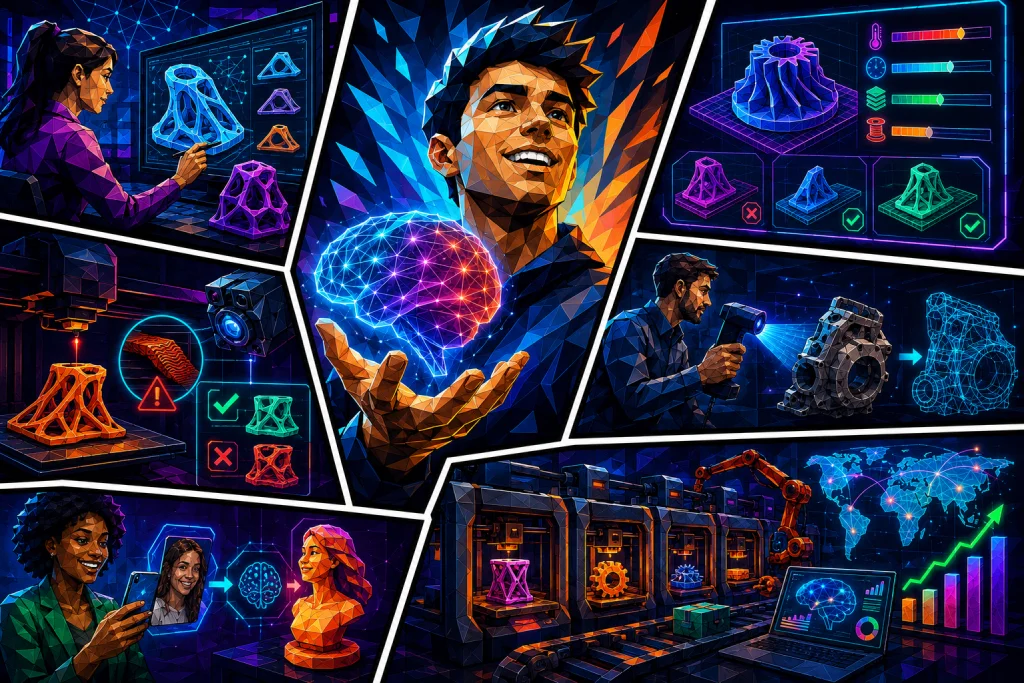
AI already plays a decisive role in 3D print and is changing how we develop and manufacture physical products. When the two technologies work together, they automate design processes, optimise production, and reduce errors. Artificial intelligence improves precision and stability in everything from generating models to slicing and ongoing quality control. In this article, we show how AI affects every phase of the 3D print process – and why it has a direct impact on future production methods.
Design automation and generative design
AI generates functional 3D designs based on defined requirements such as dimensions, load, and desired strength. The user specifies the framework, and the algorithm calculates solutions that utilise the material efficiently. The finished geometries often deviate from conventional shapes and create light, strong, and print-friendly components. This shortens development time and leads to more efficient solutions that are optimised directly for 3D print.
Error detection and quality assurance
AI monitors the printing process in real time and registers errors as they occur. Using machine learning and image analysis, the system identifies problems such as warping, layer shifts, and under-extrusion. It stops the print or adjusts the settings before materials and time are wasted. This automatic control reduces errors, increases reliability, and frees the operator from constant manual monitoring.
Improvement of slicing and print parameters
AI analyses the 3D model and automatically adapts slicing settings such as layer height, temperature, and speed based on the geometry. The system chooses the optimal orientation, minimises the use of support structures, and reduces waste. This shortens production time and increases quality – even for complex items. At the same time, AI removes the need for manual adjustment and makes the process more stable and accessible to more users.
AI in 3D scanning and reverse engineering
AI improves 3D scanning by removing noise, correcting errors, and filling in missing data. When you scan a physical object, AI processes the raw data and prepares the model for printing. This is particularly useful in reverse engineering, where you need to recreate broken or discontinued components without access to original CAD files. AI recognises structures and reconstructs an accurate, printable version, ready for production or repair.
New business models and scalability
AI makes it possible to deliver customised 3D print solutions without slowing down the production pace. For example, a user uploads an image, and an AI model automatically generates a personal 3D file, ready for print. When this process is coupled with an automated production line, it becomes possible to mass-produce unique products without manual processing of each order. At 3D actions, we use the same approach in the development of Dollface.ai – a platform where AI creates realistic 3D models from a single image.
Future perspectives: what brings the next step?
AI is no longer just a tool, but increasingly an active player in the production process itself. Imagine print farms where AI monitors all machines and learns from every print. The system continuously adjusts to improve the result next time. Or design tools integrated into webshops, where the customer is shown their product in real time, adjusted with AI, and sent directly to print. The future is not far away, and much of it already exists in pilot form and is continuously becoming more accessible.
How AI is changing the entire way we 3D print
AI transforms the entire 3D print process – from design and preparation to quality assurance and production. It reduces errors, shortens workflows, and provides access to solutions that previously required extensive experience and manual adjustments. At the same time, it makes it possible to offer tailored products on a large scale without losing efficiency.
What is generative design with AI?
Generative design uses AI to create components based on dimensions, load, and function. The algorithm generates geometries that are often lighter and stronger than traditional shapes. This saves time in development and creates solutions that are directly optimised for 3D print.
How does AI detect errors during printing?
AI uses image analysis and sensor data to monitor the print in real time. It detects errors such as warping or layer shifting and stops the print or adjusts the settings. This reduces waste and ensures a more stable production with higher quality.
Can AI improve slicing and print settings?
Yes, AI optimises slicing by analysing the model and choosing the best parameters. It adjusts layer height, temperature, and support automatically and finds the most efficient orientation. The result is better quality, shorter print time, and fewer errors.
How is AI used in 3D scanning?
AI helps clean and improve data from 3D scans. It removes noise, fills in gaps, and reconstructs models from incomplete inputs. This is especially useful in reverse engineering, where physical objects must be recreated without existing files.
Does AI make it easier to mass-produce unique items?
Yes, AI makes it possible to scale the production of individual products. By automating the entire process – from input to print – companies can mass-produce tailored items without manual processing. This opens up entirely new business models.
What can we expect from AI and 3D print in the future?
AI will increasingly control the entire production line. We are already seeing print farms where the system learns from each print and optimises automatically. Design tools are being integrated into webshops where the customer customises the product, and AI sends it directly to production at our facility.