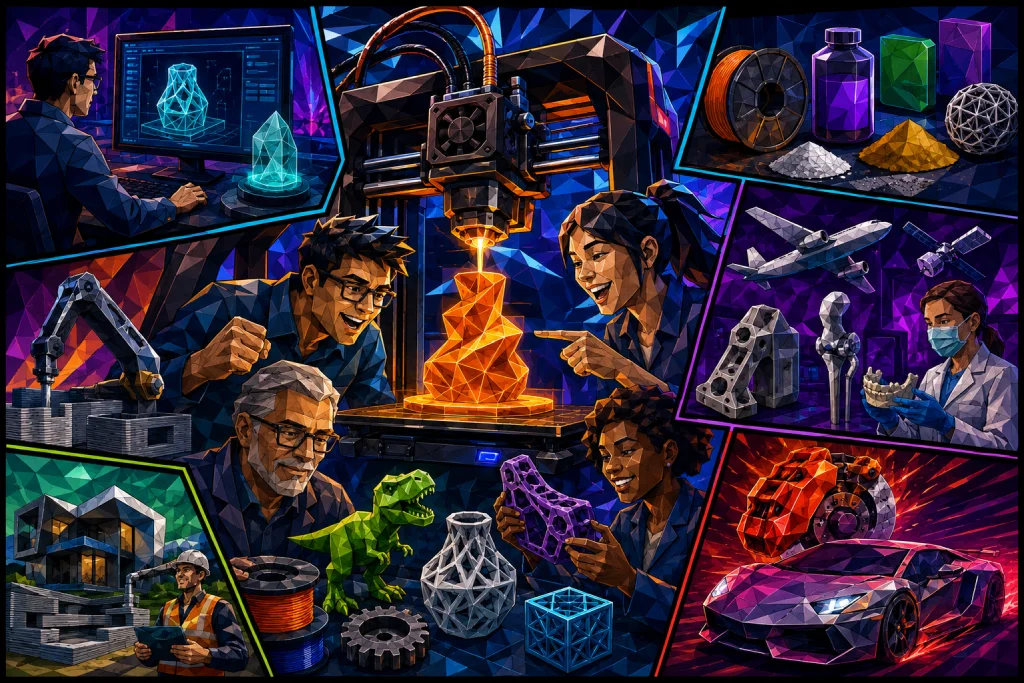
How 3D print works – an introduction
3D print is an innovative manufacturing technique that builds physical objects layer by layer based on digital 3D models. The method has fundamentally changed many business sectors and enables fast and flexible production for both companies and individuals. But what exactly does 3D print entail, and how does the technique work? This article examines the central 3D print technologies, material choices, application possibilities, and future developments. The technology originated in 1981 when Dr. Hideo Kodama experimented with UV-curing resin. Since then, 3D printers have gone from costly industrial machines to affordable desktop models, where budget-friendly variants like the Creality Ender-3 can be purchased for under 200 USD (approx. 17,000 INR).
How does 3D print work?
3D print builds physical objects layer by layer based on a digital 3D model. The process begins in CAD software (Computer-Aided Design), where the model is designed. Afterward, slicer software converts the model into layers and generates a G-code, which controls the printer’s movements and material flow.
3D print technology varies depending on the method. Most 3D printers use either an extruder that melts plastic and applies it layer by layer, or a laser that cures resin or melts powder materials. One of the most advanced technologies, Selective Laser Sintering (SLS), builds objects by fusing powder particles together layer by layer, a technique inspired by sintering processes used in ceramics and metalworking.
The different 3D print technologies
Several technologies are used for 3D print, each with its advantages and disadvantages. The most commonly used methods include:
- FDM (Fused Deposition Modeling): The most widely used method, where a heated nozzle melts a plastic thread (filament) and applies the material layer by layer. Scott Crump invented the technology and patented it in 1989, leading to the founding of Stratasys.
- SLA (Stereolithography): A precision method that uses a laser to cure liquid resin. Chuck Hull patented the technology in 1986 and created the STL file format, which remains the industry standard.
- DLP (Digital Light Processing): A variant of SLA that uses a digital projector to cure an entire resin layer at once, making the process faster.
- SLS (Selective Laser Sintering): Melts powder materials like plastic and metal using a high-power laser. Carl Deckard developed the method in 1988 at the University of Texas.
- MJF (Multi Jet Fusion): Developed by HP to create strong and precise components using a heat source and a chemical binding agent.
- Binder Jetting: Uses a binding liquid to glue powder material together, suitable for metal, sand, and ceramic parts.
- EBM (Electron Beam Melting): Uses an electron beam to melt metal powder, primarily used for titanium and cobalt-chrome alloys in aerospace and medicine.
Modern innovations like Klipper firmware have improved FDM printing by optimizing motion control and reducing vibrations, increasing speed by up to 200%.
Materials for 3D print
Material choice is determined by the finished product’s purpose. The most used materials in 3D print include:
Plastic
PLA, ABS, PETG, and PEEK are among the most used plastic types. PLA is biodegradable and popular for hobby projects. ABS is stronger and often used for functional parts, while PETG combines flexibility and durability. PEEK is an advanced plastic that withstands temperatures up to 250°C and is used in aerospace and medical implants.
Resin
Liquid resin is used in SLA and DLP printers. Standard resin is suitable for detailed prints, while flexible resin is used for elastic parts. Dental resin is used in the dentistry industry, and engineering resin is developed for high-strength mechanical components. The price varies from 3,500–14,000 INR per liter.
Metal
3D print in metal uses powder-based technologies like SLS and EBM. Aluminium, titanium, and cobalt-chrome are widespread in aerospace and the automotive industry. Titanium alloys are especially used in orthopedic implants due to their low weight and strength. Metal powder can cost between 60,000 and 180,000 INR per kg depending on the alloy.
Ceramics and composites
Ceramic materials are used in medical implants and artistic projects. Composite materials combine plastic with glass or carbon fiber to create stronger and lighter components.
PLA became the most popular plastic type after 2007 when the RepRap project made the technology widely accessible.
Application areas for 3D print
Several industries use 3D print for flexible and fast production:
- Industrial production: Factories use 3D print to manufacture prototypes, spare parts, and small production series.
- Healthcare sector: 3D print plays a central role in medical implants, prosthetics, and surgical models. Titanium implants are used in orthopedics and dental surgery.
- Construction and architecture: Architects and engineers create models and experiment with 3D-printed houses. In the Netherlands, a bridge has been constructed with concrete print.
- Automotive and aerospace: Manufacturers like Airbus, Boeing, and Bugatti use 3D print to create light and strong components. Bugatti developed the world’s first 3D-printed titanium brake caliper.
- Consumer products: Brands like Adidas have launched running shoes with 3D-printed midsoles for a tailored fit.
- Bioprinting: Researchers experiment with bioprinting living tissue, including cartilage and skin cells. Aarhus University and DTU are working on tissue structures that could revolutionize regenerative medicine.
Advantages and Challenges of 3D Print
3D print has changed production methods in several industries, but the technology has both advantages and limitations.
Advantages of 3D Print
3D print has transformed production methods by making it possible to manufacture customized parts quickly and efficiently. The technology reduces both development time and material waste, making it attractive for companies seeking flexibility in their manufacturing processes.
- Customized Production: 3D print makes it possible to manufacture specially designed components without the need for expensive production series. Companies like LEGO and BMW utilize the technology for test production and rapid development of new products.
- Faster Prototypes: Product development is significantly faster, as companies can print functional prototypes directly from CAD software instead of waiting for tool manufacturing.
- Reduced Material Waste: Unlike CNC milling, where up to 80% of the material can go to waste, 3D print only uses the necessary material. This makes the technology more resource-efficient.
- Increased Print Speed: Klipper firmware optimizes speed and reduces vibrations, which doubles the print speed for FDM printers with CoreXY construction.
Challenges of 3D Print
Although 3D print offers many advantages, the technology also has limitations. Material choice, post-processing, and production speed are factors that still make it less competitive compared to mass production using traditional methods.
- Material Limitations: Not all materials are suitable for 3D print. ABS and PEEK require high temperature control to avoid shrinkage, while SLA resins can be fragile without post-processing.
- Longer Production Time: Injection molding can produce thousands of parts per hour, while 3D print typically takes several hours per item. This makes the technology less suitable for mass production.
- Post-processing is Often Necessary: SLA prints must be UV-cured, and metal prints often require polishing or sandblasting to achieve the desired quality. These extra steps can increase both time consumption and costs.
3D Print and Pricing
Several factors determine the price of a 3D print. Material consumption, 3D print time, and the complexity of the design play a decisive role, but post-processing and the choice of print technology can also affect the total price.
Material consumption is of great importance, as different materials vary in price. PLA filament typically costs between 1,600–3,200 INR per kg, while SLA resin can cost 3,200–12,800 INR per liter, depending on quality and properties. For more advanced prints, such as metal print with SLS or EBM, the price for powder materials can lie between 53,000 and 160,000 INR per kg.
3D print time also affects the price, as longer prints consume more power and wear on the printer’s mechanical parts. FDM printers are the cheapest to operate with an average print cost of 20–55 INR per hour, while more advanced technologies like SLA and SLS can cost between 100–550 INR per hour.
The complexity of the design plays a significant role. If a print requires many details or support structures, both material consumption and 3D print time increase, thereby increasing the total price. Post-processing, such as UV-curing of SLA prints or polishing of metal parts, can also add extra costs.
When Creality launched the Ender-3 in 2018, 3D print became significantly more accessible. With an introductory price of approximately 16,000 INR, the printer made it possible for hobbyists and small businesses to produce high quality at a fraction of previous costs. The Ender-3 paved the way for a wave of budget-friendly 3D printers and lowered the barrier to entry for many new users.
The Future of 3D Print
The development within 3D print is moving fast, and new technologies are significantly changing the field. The most promising innovations include bioprinting, nanoprinting, and AI optimization, all of which contribute to expanding the application possibilities.
- Bioprinting: Focuses on creating living tissue and is actively researched in the development of functional organs. Researchers have already 3D-printed heart tissue, cartilage, and skin, while companies like Organovo work with liver cell printing for medical tests. In Denmark, DTU and Aarhus University experiment with bioprinting of cartilage and skin cells, which could revolutionize future treatments.
- Nanoprinting: Used to manufacture extremely small structures and plays a central role in electronics production and medical applications. In the semiconductor industry, 3D-printed transistors and sensors are being tested, while companies like Nanoscribe develop microstructures for optical and biological applications.
- AI Optimization: Improves 3D print processes by adjusting parameters in real-time to decrease errors and reduce material waste. Google DeepMind and Autodesk have developed AI-driven design solutions that create lighter and stronger components. In the long run, AI can revolutionize production by making print processes more precise, sustainable, and efficient.
What is 3D print, and how does it work?
3D print is a manufacturing method where an object is built layer by layer based on a digital model. The process starts with a CAD file converted to G-code, which controls the printer’s movements. Depending on the technology, plastic, resin, or metal powder is melted to create the desired shape.
Which materials can one use for 3D print?
One can use plastics like PLA, ABS, and PEEK, resin for detailed prints, as well as metals like titanium and aluminum. The choice of material depends on the purpose—plastic is suitable for prototypes, while metal is used for strong, durable components in the industry.
How long does it take to print a model?
3D print time depends on size, complexity, and technology. Smaller objects can take a few hours, while large or detailed models can take over 24 hours. FDM is faster, while SLA and SLS can take longer due to curing or sintering of the material.
Can one 3D print functional parts?
Yes, many industries use 3D print for functional parts. Plastics like ABS and PEEK can withstand high temperatures and loads, while metal print is used for strong components in the automotive and aerospace industries. Post-processing like curing or polishing can improve strength and durability.
What is the difference between FDM, SLA, and SLS?
FDM prints with melted plastic thread layer by layer, SLA uses a laser to cure liquid resin, and SLS melts powder material with a laser. FDM is the cheapest and most widespread, while SLA provides a high level of detail, and SLS is used for strong, functional parts without the need for support structures.
Can one print biological materials with 3D print?
Yes, bioprinting makes it possible to print living tissue using cell-based materials. Researchers have already 3D-printed skin, cartilage, and simple organ structures, but fully functional organs are still under development. Danish research institutions are actively working with this technology.
Turn Your Ideas into Reality with 3D Print
3D print is a flexible manufacturing technology that makes it possible to produce quickly and in a customized way, whether it involves simple prototypes or advanced industrial products. With a wide selection of technologies and materials, companies, designers, and hobbyists can create functional and aesthetic parts for specific needs.
If you wish to have a model printed or find the best prices for 3D printers and materials, you can get a fast and precise price calculation here: [3D print price calculator]