What does 3D print really cost? Guide to total cost of ownership
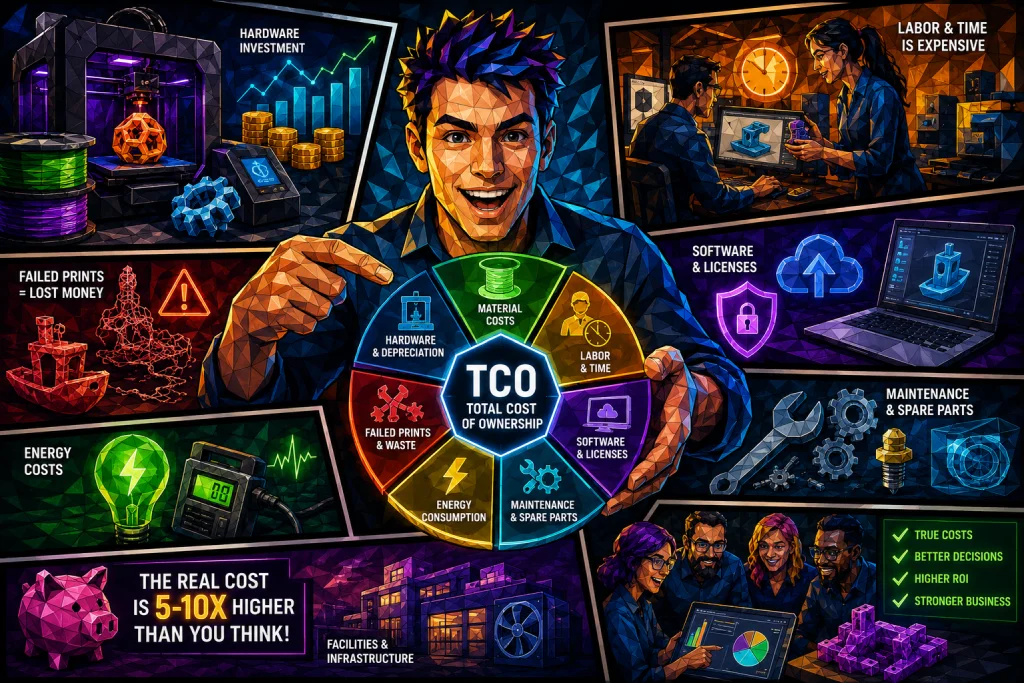
Many companies and decision-makers make the mistake of only looking at the price of a spool of filament when budgeting for 3D print. But the reality is that the material expense often only constitutes the tip of the iceberg. To make an economically sustainable decision, it is necessary to know the full Total Cost of Ownership (TCO).
This guide reviews the hidden costs and financial key figures that determine whether your investment in 3D print technology becomes a gain or a drain on the bottom line of the accounts.
What does the term Total Cost of Ownership (TCO) cover in 3D print?
Total Cost of Ownership (TCO) is a calculation that reveals the total costs of acquiring, operating, and maintaining a 3D printer throughout its entire lifespan. Unlike the simple 3D printer acquisition price, TCO includes factors such as installation, power, operator time, software licenses, failed 3D prints, and facility management.
When you calculate TCO, you must look at the entire workflow. It starts at 3D design and software preparation, goes through the 3D print itself, and ends at post-processing and maintenance. Experts have documented that one must avoid locking into platforms that drain the budget with hidden costs, which requires a complete review of all expense items.
For professional actors, this calculation is critical. It is not just about the 3D printers price, but about the 3D print price per produced unit when wages, rent, and downtime are offset.
Which direct costs for hardware and materials are often overlooked?
The most overlooked costs for hardware are those that arise after the purchase. A 3D printer consists of wear parts, also called consumables, which wear naturally and are therefore never covered by the warranty. You must budget for ongoing replacement of parts like print cores, which typically cost around 8,500 INR each, and glass build plates at approximately 2,400 INR.
Operational reliability is another essential factor. If a machine is unreliable, the costs for material waste and troubleshooting increase significantly. A high success rate is equal to higher productivity. This becomes exponentially more important if you scale up.
The maintenance complexity for a 3D printer farm with 150 machines is enormous, as you are no longer just servicing one unit but must manage the logistics for hundreds of nozzles and moving parts.
Power consumption is also a fixed operating cost. A professional machine like an Ultimaker S5 uses an average of 300 Watts (0.3 kWh) during the 3D print itself. If you run a production with 1,500 hours of operation a year, it corresponds to an annual consumption of approximately 450 kWh per machine.
Why are post-processing and wages the biggest economic trap?
Labor is often the most expensive item in the TCO account. Even though the 3D print itself is an automated process, preparation and post-processing require manual hands.
Training of personnel is the first barrier. Although a simple introduction can be managed in 30 minutes, it typically takes around three hours for an employee to achieve productive knowledge of the entire workflow. This time is a direct investment that must yield a return.
Post-processing of 3D print can vary from removing a simple brim to extensive sanding, polishing, or curing, which requires special tools and chemicals like isopropyl alcohol. The choice of technology plays a large role here. FFF technology (Fused Filament Fabrication) generally generates less waste than SLA or SLS, where one must continuously dispose of contaminated resin or powder.
To minimize operator time and the risk of failed prints, it may be necessary to optimize the process technically. Experienced operators know, for example, that for certain materials one should raise the temperature to 240-260 degrees to ensure a stable flow at high speeds, even if the standard says something lower. 3D print errors in this phase are expensive in both time and material.
How do software licenses and digital infrastructure affect the price?
Many companies assume that the software comes free with the 3D printer. This is often only partially true. While basic versions of slicing software may be free, several manufacturers charge for advanced functions.
If your company has strict requirements for IP security and therefore requires offline versions of the software, this can trigger an extra license cost. The same applies if you want to scale your production. Software for managing multiple 3D printers via a network is considered by some manufacturers as an enterprise function that requires payment.
You should also utilize the software to predict costs. Programs like Ultimaker Cura can calculate precise 3D print time and material consumption before start, making it possible to know the 3D print price of a part before you have even bought the machine.
What does downtime and maintenance cost in a professional production?
A 3D printer that stands still costs money. In professional production, downtime is critical, which is why many choose to sign service agreements. You should expect a service agreement to cost between 15% and 20% of the printer’s new price every single year. For certain industrial machines, these agreements are even mandatory.
Maintenance also requires a fixed routine. Based on 1,500 hours of annual operation, it is recommended to clean the 3D printer monthly, lubricate shafts every three months, and replace Bowden tubes annually.
When you invest in hardware, you must also ensure legacy support. It is crucial to know if the manufacturer will stock spare parts after the 3D printer is discontinued. A good rule of thumb is to require a spare parts guarantee for up to three years after production stop, so you are not forced to scrap a functioning machine.
The problems in any sort of given product are always in the start-up and the shut-down.
How is the economic return (ROI) measured in a 3D print business?
To assess whether in-house 3D print is a good business, you must look at the financial key figures. A sustainable business model should aim for a gross profit of approximately 25% and a net profit of 10%. If your margin is so low that a fee of a few percent can overturn the budget, the business model is too fragile.
Strategic planning of the financial year can also affect your ROI. For companies with seasonal fluctuations, such as high activity around the festive season, it can be an advantage to end the financial year in October. This places the year’s largest earnings at the start of the new financial year, providing 10-12 months to strategically reinvest the surplus in new equipment and stock before the next tax assessment.
The choice of business structure is also relevant for ROI. In the startup phase, it can often pay to start as a sole proprietorship and wait to establish a limited company until the turnover justifies the increased administrative costs.
When does it pay to outsource the 3D print itself rather than owning?
The decision to own (in-house) or outsource to a service bureau depends on whether you want to run a machine shop or focus on your product.
There are significant facility requirements for having production in-house. Industrial 3D printers may require dedicated rooms with HVAC-certified ventilation, and even smaller desktop 3D printers can require air filtration that removes up to 95% of ultrafine particles. These costs for renovating premises are often forgotten in the TCO analysis.
Here is a comparison of the two models:
| Parameter | Own ownership (In-house) | Service Bureau (Outsourcing) |
| Initial investment | High (Machines, facilities, ventilation) | Low (No hardware expense) |
| Ongoing expenses | Power, materials, licenses, spare parts | Variable price per unit |
| Risk | Downtime, technological obsolescence, failed prints | Minimal (The supplier bears the risk) |
| Labor | Requires internal specialist and time for operation | No internal time spent on operation |
| Scaling | Difficult (Requires purchase of more machines) | Easy (Order more units as needed) |
What does it cost to 3D print in power?
Power consumption is a fixed operating cost that depends on the printer’s wattage and operating hours. A professional machine like the Ultimaker S5 uses an average of 300 Watts (0.3 kWh) during print. At 1,500 hours of annual production, this corresponds to a total consumption of approximately 450 kWh per machine.
Is it cheapest to buy a 3D printer or use a service bureau?
It depends on whether you want to run a workshop or focus on your final product. Outsourcing removes the risk of technological obsolescence, downtime, and personnel costs, which often provides a better ROI. In-house production requires investments in specialists, facilities, and ventilation for the removal of ultrafine particles.
What are the biggest hidden costs of 3D print?
Labor for preparation and post-processing is often the most expensive and most overlooked item in the TCO account. Although the print is automatic, the process requires manual hands for cleaning and curing. Furthermore, expenses for renovating premises to ensure correct ventilation are often forgotten.
How much does maintenance of a professional 3D printer cost?
You should expect an annual service agreement to cost between 15% and 20% of the 3D printer’s new price. To avoid downtime, a fixed routine is required where the 3D printer is cleaned monthly, shafts are lubricated every three months, and parts like Bowden tubes are replaced annually during professional use.
How do you calculate the hourly price of 3D print?
The hourly price is calculated by summing the 3D printer’s depreciation, power consumption, licenses, and operator wages. One must look at the entire workflow from design to post-processing. The price per unit increases significantly when factors such as rent, downtime, and failed prints are offset in the final calculation.
What do spare parts and wear parts for 3D printers cost?
Wear parts, called consumables, wear naturally and are never covered by the warranty, which is why they must be budgeted for continuously. For example, a 3D print core typically costs around 8,500 INR, while a glass build plate costs approximately 2,400 INR. Remember also to require a spare parts guarantee for three years after production stop.
Master your TCO and choose the right strategy
It is clear that the price of the 3D print itself is much more than just the material price. When you include labor, service agreements (15-20% annually), facility requirements, power, and software, the real price is often 5-10 times higher.
By understanding your Total Cost of Ownership, you can make an informed choice. For many companies, the best ROI is not to invest in a machine fleet, but to utilize a professional 3D print service that has economies of scale and expertise. This frees up your resources for what creates value: Design, product development, and sales.