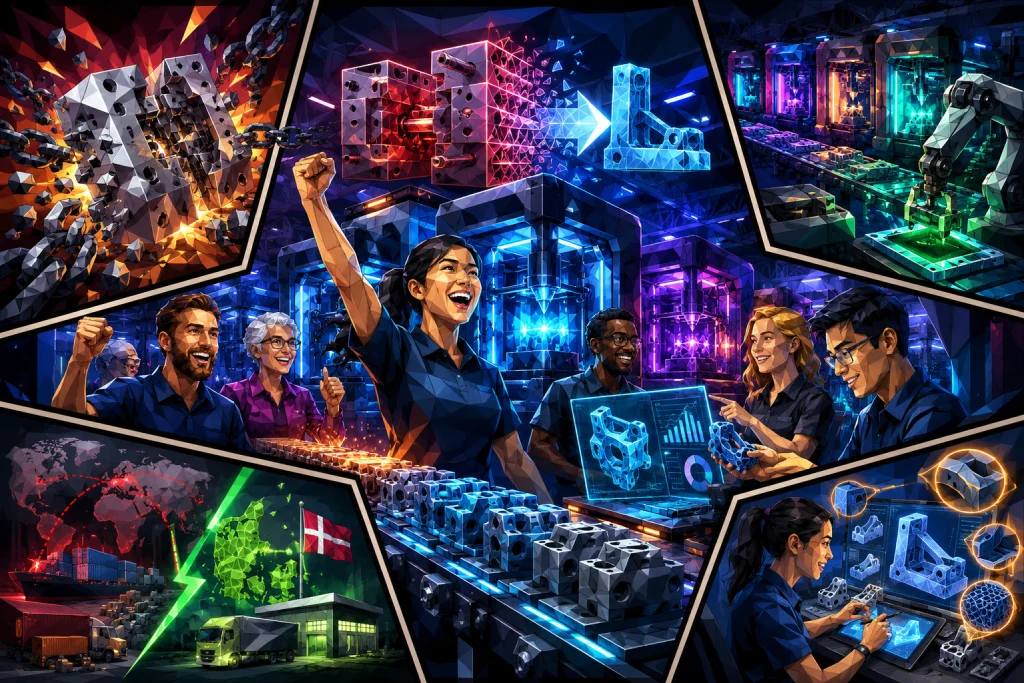
Optimise your supply chain and remove hidden costs with on-demand production
Companies often search for cheap alternatives to traditional injection moulding when producing smaller quantities. A traditional aluminium mould quickly costs 85,000.00 INR for even very simple geometries. You should avoid this large initial investment by using a 3D printer for your small series. This approach removes the economic barriers and lets you start your production immediately.
[Get your 3D print price]
The advantages of series production with a 3D printer
You achieve significantly higher flexibility when you remove the need for physical moulds. A 3D printer works directly from your digital files, which means you should adjust your design continuously without extra costs. Traditional methods lock your capital in expensive tooling before you even have the first item in hand. You should instead use on-demand production to test the market or produce spare parts as needed. This choice minimises your risk and ensures that you do not get stuck with unsold goods.
Understanding the real 3D print price through amortisation
Many decision-makers make the mistake of only looking at the material price per item. An injection-moulded part might only cost 8.50 INR, while the 3D print itself costs 60.00 INR. However, you must remember to include the amortisation of the mould. If you distribute the 85,000.00 INR for the mould across a series of 1,000 items, your real price per piece rises to 93.50 INR. In this scenario, you save 33.50 INR per item by choosing a 3D printer. Your total 3D print price therefore becomes more competitive when you include the full project costs. You should always perform this calculation to get the true picture of your economy.
Design optimisation as a tool for lower costs
Your design directly affects both your 3D print time and the final price. You should round all vertical edges in your 3D models, as it creates a more efficient toolpath for your 3D printer. An optimised toolpath means the machine moves smoothly, which improves the quality of the 3D print itself. You should also consider the item’s orientation on the build plate. By placing the items correctly, you exploit the machine’s capacity in the best way possible and reduce the total 3D print time for the entire series.
Technical steps to improve the 3D print itself
You should always add a chamfer of at least 1 mm at the bottom of your item. This geometric detail prevents the phenomenon that professionals call “elephant footing”. Elephant footing occurs when the first layers of the 3D print itself are pressed out to the side, destroying the item’s precision. A chamfer ensures that your 3D printer lays the first layer flawlessly every time. Furthermore, you should exploit the opportunity to add digital textures directly in the CAD software. You can add patterns like cross-hatching completely for free, which hides layer lines and provides a homogeneous surface. This would be extremely expensive to perform on a traditional mould.
Automation and reduction of manual labour
Manual labour is often a large item in your budget for series production. You should design a small indentation at the bottom of your items to decrease the contact surface with the build plate. This step is essential to enable auto-ejection. Auto-ejection means that your 3D printer automatically pushes the finished items off the plate without human intervention. When you remove the need for manual handling of thousands of parts, your 3D print price drops significantly. This form of automated 3D actions makes it possible to run production 24 hours a day at our facility.
Strategic planning and machine utilisation
You achieve the best prices by thinking in long-term agreements rather than one-off orders. If you order 100,000 items for delivery in two months, it creates a peak load for the machines. You should instead choose a sequential delivery, where you receive, for example, 1,000 items every 30 days. This model ensures uniform machine utilisation, which allows us to give you a better 3D print price. You also get the advantage of a close feedback cycle. If you discover an error in a small batch, we should correct it immediately instead of producing thousands of faulty parts.
Local production at our facility reduces logistical risks
Traditional production often requires shipping over long distances. A container shipment from abroad typically costs between 42,000.00 INR and 85,000.00 INR in freight alone. Furthermore, it entails long waiting times and uncertainty in the supply chain. You should choose local production through our 3D actions to remove these expenses. By producing locally, you reduce your storage costs to a minimum. Storing large quantities of goods costs between 170.00 INR and 850.00 INR per month per square meter. You avoid this capital tie-up and the risk of waste, as you only receive the items you actually need. Statistics show that companies often discard between 10 and 25 percent of their inventory because the products are never sold. You should avoid this waste by producing on-demand.
When is 3D print cheaper than traditional injection moulding?
The 3D print itself is normally cheapest for series sizes under 10,000 items, where high tooling costs are not profitable. You should calculate your 3D print price by including savings on storage and freight. This method removes the fixed expenses for moulds, which often cost over 85,000.00 INR.
Which factors have the greatest significance for your 3D print price?
Geometry, material choice, and the total 3D print time are the most decisive factors for the final price. You reduce your costs by removing manual labour through auto-ejection and choosing efficient materials. The faster your 3D printer can complete the item without errors, the lower your total price becomes.
How can design help lower the price of the 3D print itself?
You lower the price by using rounded corners and minimising the contact surface against the build plate in your 3D printer. A well-thought-out design reduces the amount of support material and significantly shortens the required 3D print time. These technical 3D actions ensure stable production that minimises waste and saves money in the budget.
Can longer delivery time provide a lower price on series production?
Yes, you achieve a better 3D print price by choosing longer delivery times or sequential deliveries. This allows us to optimise our machine utilisation and distribute the costs across multiple projects. By receiving your items continuously, you also reduce your own expenses for storage space and capital tie-up each month.
How much do you save on storage and waste with on-demand production?
You typically save between 170.00 INR and 850.00 INR per square meter per month by avoiding large physical warehouses. Since you only have the items you need produced, you remove the risk of discarding up to 25 percent of your production. Local production through 3D actions ensures results.
Is the quality of a cheap 3D printed item good enough for end-use?
Professional 3D actions ensure a quality that fully measures up to traditional production methods for many purposes. You can hide layer lines completely for free by adding digital textures to your design before the 3D print itself begins. This gives your items a uniform and professional surface finish at a sharp price.
Start your journey towards more efficient production today
You have now gained insight into how to use a 3D printer to create a cheap and efficient series production. By focusing on correct design, smart machine utilisation, and local production, you remove the heavy items in your budget. You should contact us at 3D actions to get a precise assessment of your next project. Our experts are ready to help you optimise your 3D actions and ensure you the best 3D print price on the market.
Let us have a dialogue about your needs and find the right solution for your company right now.