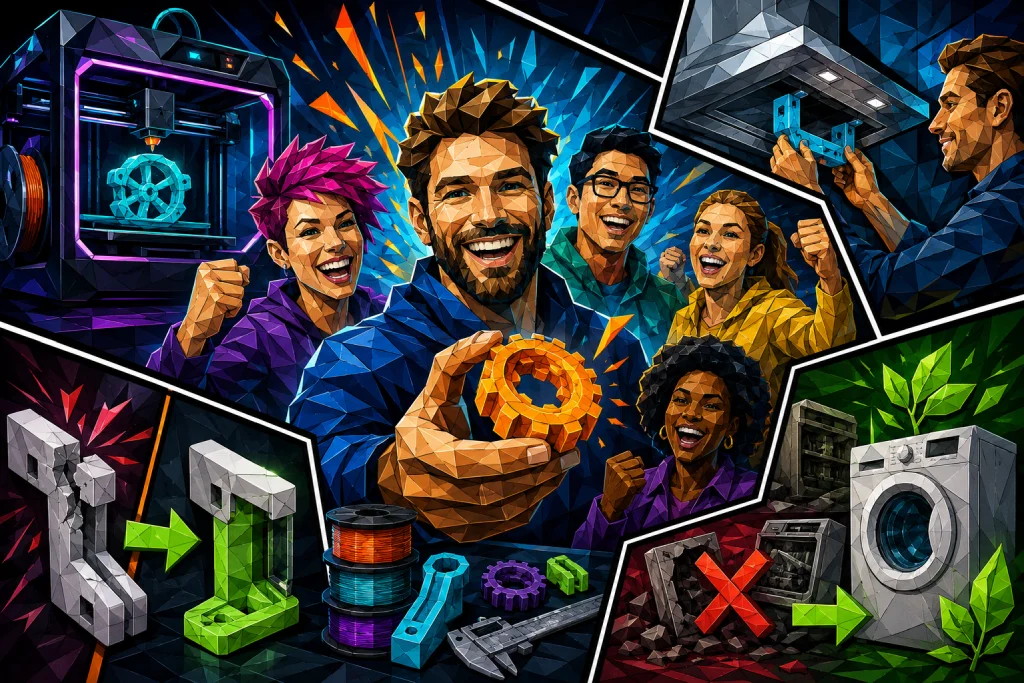
Save money and protect the environment by replacing broken plastic parts with local production
You should see repair as your strongest tool against waste. Every time a small plastic part breaks in an extractor hood, a vacuum cleaner, or a piece of toy, you face a choice. You can throw out an otherwise functioning product, or you can recreate the defective part. A new washing machine easily costs 48,000.00 INR, while the 3D print of a spare part itself often costs under 1,800.00 INR. By choosing a 3D printed solution, you fight planned obsolescence and ensure that your belongings live longer. It is common sense for both your bank account and the environment.
What does a 3D printed spare part cost compared to a new machine?
The price difference between a repair and a new acquisition is often enormous. An industrial injection mould for a simple plastic part typically costs between 300,000.00 and 2,940,000.00 INR. This high startup cost means that manufacturers rarely stock spare parts for older models. With a 3D printer, you remove the need for expensive moulds. You only pay for the actual 3D print time and the amount of material that the task requires at our facility.
Which everyday objects are best suited for repair with 3D print?
You should look for objects where the fault is mechanical and limited to a plastic component. This often applies to gears in kitchen appliances, brackets for extractor hoods, buttons for the dashboard in the car, or small plastic clips for the dishwasher. Toys are also an obvious category. If an arm on a figure breaks, or a gear in a remote-controlled car becomes worn, you should have it 3D printed rather than discarding the entire set. Even complex items like wall brackets for tools or specially designed adapters for vacuum cleaner hoses function perfectly as 3D printed projects.
How do you find or design the correct file for your 3D printer?
You should start your search on portals like Thingiverse or Printables. Here, other users have often already uploaded precise files for popular household appliances. If you do not find an existing file, you should measure your broken part with a caliper. You should then draw the component in a CAD program or get an expert to help with the modelling. When you have your file ready, you upload it directly to our price calculator. Here you will immediately be informed of your 3D print price, so you know your costs before production starts.
Which materials ensure that your 3D printed part holds up to daily use?
You should always choose material based on the load that your spare part will be subjected to. If the part is to be placed in a lamp or close to a motor, you should avoid PLA as it becomes soft with heat. Here you should instead choose PETG or the even stronger PCTG, which withstands temperatures up to around 80-90 degrees. For mechanical parts with high impact strength, you should use ABS. If your spare part requires extreme fine precision, you should consider having it manufactured on a resin 3D printer. By choosing the correct material, you get a part that is often more durable than the original component from the factory.
How do you calculate the precise 3D print price for a spare part?
Your final price depends on material choice, the item’s weight, and the required 3D print time. The material often only accounts for around 25 percent of the total price, while the rest covers electricity, machine maintenance, and handling. Below you can see price examples for typical repairs:
| Spare part | Weight in grams | 3D print price (estimated) | Price for new product (estimated) |
| Gear for machine | 26g | 540.00 INR | 21,600.00 INR |
| Extractor hood bracket | 72g | 1,020.00 INR | 30,000.00 INR |
| Refrigerator handle | 118g | 1,500.00 INR | 66,000.00 INR |
| Large housing part | 276g | 2,880.00 INR | 84,000.00 INR |
What extra costs are there besides the 3D print itself?
You should include expenses for post-processing if your spare part needs a specific appearance. A small bottle of glue for assembling larger items typically costs 420.00 INR. If you want a completely smooth surface, you should invest in a plastic filler for around 1,320.00 INR. Paint and primer also add a small cost to your project. Even when you include these materials, your total investment will still be far below the price of a new machine. You should consider these extra materials as an investment in getting a result that resembles the original product as much as possible.
How much CO2 is saved by choosing a 3D printed solution?
You make an important contribution to the environment when you remove the need for global shipping. Traditional production often takes place far away, where goods are sent in large containers across the globe. At the same time, up to 25 percent of all mass-produced goods are never sold but end up directly as waste. 3D print is on-demand production, which means we only manufacture what you need. By producing at our facility, we significantly minimise transport and the CO2 footprint. You therefore save both on your own economy and on the earth’s resources.
What does a 3D printed spare part cost compared to a new one?
A 3D printed spare part typically costs between 540.00 and 3,000.00 INR including material and 3D print time. This stands in sharp contrast to the price of new household machines, which often cost many thousands of rupees. You thus save a lot of money by choosing a targeted production rather than a new purchase.
How strong is a 3D printed spare part for daily use?
A 3D printed spare part is very durable if you choose the correct materials such as ABS or PETG. These materials ensure high impact strength and good heat resistance in everyday life. By optimising the design and choosing the right 3D print time, you can often create a part that exceeds the original’s strength.
Which material should be used for repairs involving heat?
You should use PETG or PCTG for parts exposed to heat, such as extractor hoods. These materials maintain their shape at higher temperatures than ordinary PLA, which risks deforming. It is crucial for safety and durability that the material matches the environment in which the spare part will function in the future.
How do I find a 3D file for my broken spare part?
You should start by searching online databases such as Thingiverse or Printables for your specific model. If the file is not found, you should measure the broken part and have it drawn in a CAD program. Once you have the file ready, you can quickly find your 3D print price.
How long does it take to have a spare part 3D printed?
The 3D print itself typically takes from a few hours to a day depending on the item’s size and complexity. To this must be added time for any preparation of files and shipping from our production. You normally receive your finished part within a few working days after your order.
Is 3D print better for the environment than buying new?
Yes, 3D print is significantly better for the environment as you reduce CO2 emissions from global shipping and production. You avoid resource waste by only producing exactly the part you are missing. By extending the life of your appliances, you minimise the amount of waste that would otherwise end up in the landfill.
Get started with your repair and get a fixed price immediately
You should not let your defective appliances sit and collect dust. By using 3D print, you give your things new life and save money at the same time. The process is simple: find your file, choose the right material, and let us handle the production at our facility.
You should upload your file to our online calculator today to see your precise 3D print price. It has never been easier to choose a sustainable and economic solution to an everyday problem.