Many entrepreneurs and companies fear that the electricity bill will run wild when a 3D printer runs for many hours at a time.
This concern often keeps people from investing in their own equipment or ordering larger tasks. The truth, however, is that a modern 3D printer uses far less power than most imagine.
Myth check: 3D printer vs. household appliances
The notion of the 3D printer as a power guzzler is a persistent myth. If we compare a modern 3D printer with machines you already use in daily life, the figures become very clear.
A typical 3D printer uses over 11 times less power during operation than an ordinary coffee machine. While the coffee machine delivers high heat in a short time, the 3D printer works with a much more efficient and steady energy distribution. Even a gaming computer or a tumble dryer draws significantly more power from the socket than your 3D printer does during the 3D print itself.
[3D print business]
Understand the three phases of your power consumption
Power consumption is not constant throughout the entire process. You should know the three phases to understand the total 3D print price:
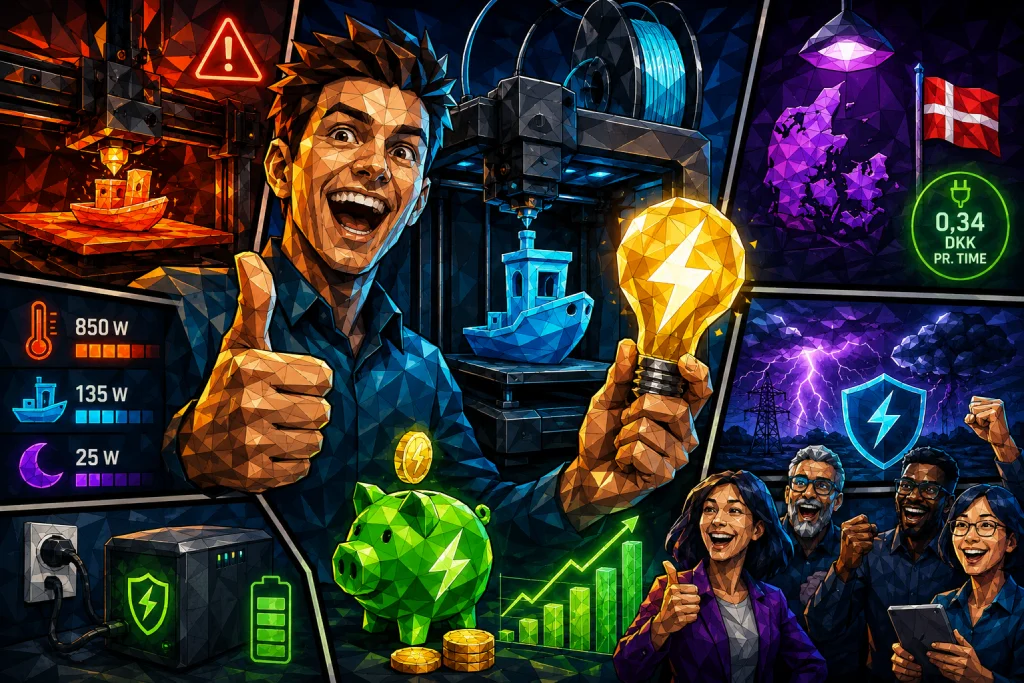
- The heating phase: This is where the machine draws the most power. A Bambu Lab 3D printer, for example, uses up to 850 watts when heating both the nozzle and the build plate. However, this phase only lasts a few minutes.
- 3D print time (Operation): This is the most important phase, as it covers 95% of the time. Here, consumption drops to an average of approx. 135 watts. The machine only uses energy to maintain the temperature and run the motors.
- Standby (Idle): When your 3D printer is turned on without working, it uses around 25 watts. The power here goes to the screen, the light, and the internal fans.
Price calculation: What does 10 hours of 3D print cost?
It is easy to calculate your exact 3D print price for power. Locally, the average electricity price is often around 7 INR per kWh (including taxes).
If you run a 3D print for 10 hours with an average consumption of 135 watts, the calculation looks like this:
1.35 kWh x 7 INR = 9.45 INR.
Even if you run a small print farm with five machines running 12 hours a day every single day, the power rarely constitutes more than a small fraction of your total electricity bill. In many cases, it corresponds to an increase of only 12% compared to a normal household’s power consumption.
| Phase | Consumption in Watts | Price per hour (at 7 INR/kWh) |
| Heating | 850 W | 5.95 INR |
| 3D print time | 135 W | 0.95 INR |
| Standby | 25 W | 0.18 INR |
Factors affecting your 3D print price
Several elements determine how much power your 3D printer actually uses. Material choice plays a major role, as materials like ABS or Polycarbonate require higher temperatures than PLA. A higher temperature on the build plate increases power consumption. You should consider using a closed cabinet (enclosure), as it retains the heat and reduces the energy the machine spends on reheating the plate.
The design of the 3D print itself also affects the economy. Since 3D printed items are not always homogeneous (isotropic), they can be weaker in the Z-axis. You should design your items for the process by, for example, increasing the surface area by 15% in critical directions. This ensures the same strength as traditional machining without significantly increasing your 3D print time or your power consumption.
[Calculate your 3D print price here]
What is the risk of fire and thermal errors in 3D print?
Previously, fire hazard was a real concern in the 3D print environment. However, modern 3D printers are equipped with Thermal Runaway Protection. This function monitors the temperature sensor constantly. If the sensor fails, the system immediately cuts the power to the heating element to prevent overheating. You should ensure that your 3D printer has this protection activated in the firmware, as it removes the risk of dangerous situations during long 3D print times.
Protect your project: UPS and emergency power
Power outages are the biggest enemy of a successful 3D print. Although many machines have a built-in function to resume the 3D print after a power failure, this often fails in practice. The problem arises because the printer only remembers the layer it reached. This often results in “layer bulging” or shifts in the 3D print itself, which ruins the item.
You should invest in a UPS (Uninterruptible Power Supply). A UPS delivers power for 10-15 minutes after an interruption. Most power outages last only a few minutes, and with a UPS, your 3D printer continues undeterred. This saves you both wasted material and precious 3D print time on large projects.
How many watts does a 3D printer use during operation?
A modern 3D printer uses an average of around 135 watts when running at full capacity. However, consumption fluctuates depending on the temperatures you choose for the nozzle and the build plate. The low watt consumption means that you can have several machines running simultaneously without worrying about your home’s electrical installations.
Is it expensive in power to have a 3D printer running?
No, it is very cheap to have a 3D printer running compared to other electrical appliances. A 3D printer actually uses 11 times less power than a completely ordinary coffee machine. You should therefore not let the fear of a high electricity bill stop you from starting your 3D print projects.
How do I calculate the price of a 3D print?
You should calculate the price by adding expenses for material, power, and machine depreciation. You calculate the power by multiplying the machine’s average watt consumption by your current kWh price in INR. You should include a safety margin to cover any errors or necessary post-processing of the finished 3D printed item.
Can I save power by using a cabinet for my 3D printer?
Yes, you should use a closed cabinet if you want to minimize heat loss and thus power consumption. The cabinet retains the heat around the build plate, which means that the heating element does not have to turn on as often. This is especially important for materials like ABS that require high temperatures to ensure good quality.
Why do 3D prints often fail after a power outage?
The 3D print itself often fails because the machine loses its precise position when the power disappears suddenly. Although the software remembers the current layer, layer bulging or visible shifts often occur upon restarting. You should therefore secure your machine with a UPS to avoid wasting both time and material.
Is there a risk of fire if the power fails in a 3D printer?
No, modern 3D printers have built-in Thermal Runaway Protection, which automatically cuts the power in case of technical errors. This safety function constantly monitors the temperature and shuts down the machine if irregularities occur. You should always ensure that this function is active in your firmware to achieve maximum safety during operation.
Optimize your production and save money today
Power costs should never stand in the way of your projects. As we have shown, the expense for electricity is minimal compared to the value and flexibility you achieve. By designing your items correctly and securing your operation with a UPS, you minimize the risk of errors and keep your 3D print price down.
Do you need a precise calculation for your next big project? Use our online price calculator now and get a non-binding overview of your total costs for 3D print.