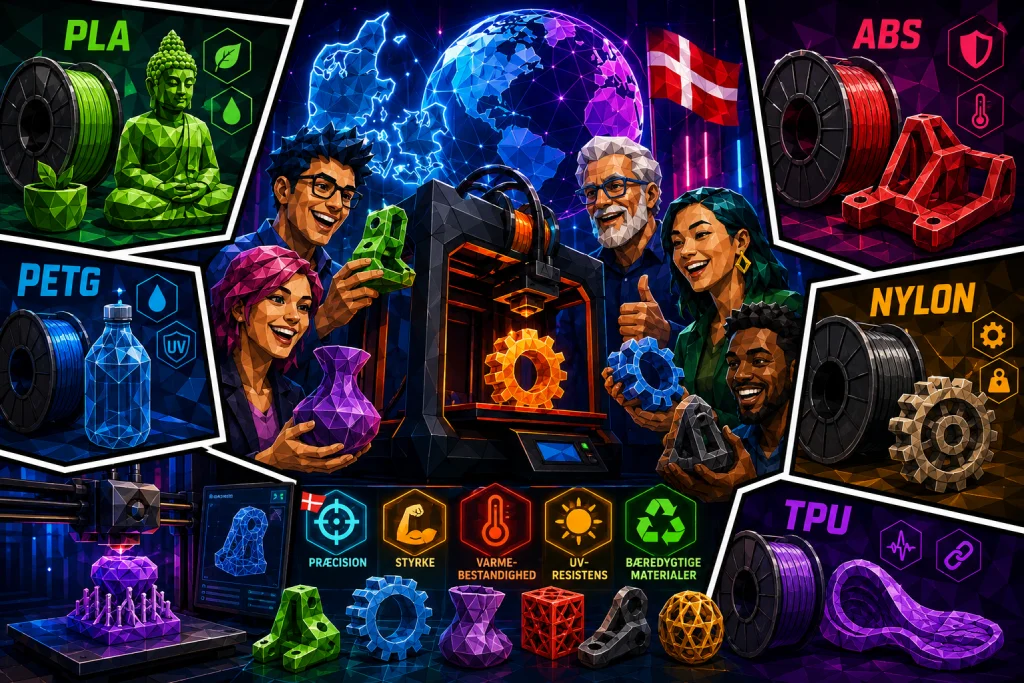
Choose the correct material to ensure functionality and durability in your items
The choice of material depends on the purpose of the item and the environment it will function in. You should use PLA for figures and visual models. You choose PETG and ABS for functional parts that require strength. Resin delivers detailed 3D prints for jewellery or small prototypes. Nylon and TPU solve tasks in technical parts that require either extreme wear resistance or high flexibility.
Find the right 3D print material and avoid technical errors
A wrong choice of material slows down your project and increases the amount of waste. You should know the difference between PLA, ABS, PETG, resin, nylon, and TPU before you order or perform a 3D print. PLA is suitable for visual models. ABS and PETG resist mechanical stress in everyday life. Resin ensures a high level of detail but requires experience with post-processing. You use nylon and TPU for parts that must bend or withstand constant wear. This guide explains which materials fit different purposes. You get an overview of strengths and weaknesses so you choose the material that actually solves the task. Read the full article and find the material that matches your project.
[Calculate 3D print price]
Why is the right choice of 3D print material crucial for your project?
The choice of material dictates the result of your project and the lifespan of the item. You choose the right material to avoid technical errors and defects. At our headquarters, we often see how the correct material choice reduces waste. The material directly determines which 3D printer technology we must apply to the task. You should match the material’s technical properties with the final purpose of the item. This ensures that your investment provides the desired value, whether you develop prototypes at our facility or send finished products across the country.
Which 3D print material gives the best result for visual prototypes?
PLA delivers the best result for your visual models and architectural projects. The material is based on corn starch and is biodegradable under controlled conditions. The material maintains precision down to 0.1 mm in the 3D print itself. You should remember that PLA loses its shape at temperatures above 60 degrees. Furthermore, the material deforms over time under constant mechanical pressure (creeping). Therefore, you only use PLA for items without heavy loads or heat influence.
When should you choose ABS over PETG for functional 3D prints?
You choose ABS for components that must withstand temperatures up to 100 degrees. LEGO uses the same material due to its high impact resistance and durability. You should use a 3D printer with a closed cabinet for this material to avoid warping (twisting of the item during cooling). PETG constitutes a strong alternative that withstands 80 degrees and the changing weather. PETG is UV resistant and works well for components that you place outdoors.
Which technical properties make nylon and TPU unique for industrial 3D actions?
Nylon offers extreme wear resistance for your industrial 3D actions. The material resists mechanical pressure in gears and bearings better than most other types. Nylon is hygroscopic (a material that absorbs moisture from the air). You should dry the material in a special oven before use to avoid errors in the 3D print itself. TPU functions as a flexible material with a Shore hardness (a scale that measures the hardness of materials) typically of 95A. You apply this to gaskets and vibration dampers for companies everywhere.
What are the benefits of advanced materials like ASA and carbon fiber?
ASA resists sunlight and wind better than other materials. You should choose ASA for technical installations on buildings or vehicles. Carbon fiber reinforces your filament and increases the stiffness of the item by up to 30 percent. This reduces the weight of your items without compromising dimensional stability. You should use hardened nozzles in your 3D printer for these materials due to their abrasive nature.
How does the geometry of the item affect your choice of 3D print material?
The geometry of your design often determines your choice of material. PLA handles complex overhangs (parts of the design that float freely) without problems because the material solidifies quickly during the 3D print itself. ABS often requires more support material, which increases your total 3D print time. You should consider the shape of the item and the need for infill (the internal filling degree in the 3D print itself) before choosing the final material. Some materials risk delamination (when the layers separate from each other) if the item has large surfaces and cools too quickly.
How does the material choice affect your total 3D print time?
Your choice of material changes the expected 3D print time significantly. Technical materials like nylon or flexible TPU often require a lower speed of around 30 mm/s to ensure quality. A standard 3D printer takes longer on complex geometries in these materials than in ordinary PLA. You should therefore plan your production according to the material’s requirements for speed and temperature. We help you balance technical quality and time consumption in your project.
Which materials are best suited for food contact or outdoor environments?
You should choose certified PETG for food contact. You must post-process the 3D print itself correctly to seal the microscopic ridges between the layers. For outdoor use, ASA works best. The material withstands temperatures from minus 10 degrees in winter to intense summer heat without losing its colour or strength.
Comparison of 3D print materials
| Material type | Max temperature | Strength | Best for |
| PLA | 60 degrees | Medium | Models and figures |
| ABS | 100 degrees | High | Technical parts and housings |
| PETG | 80 degrees | High | Outdoor items and containers |
| Nylon | 120 degrees | Very high | Gears and moving parts |
| TPU | 80 degrees | Flexible | Gaskets and covers |
What is the difference between PLA and PETG for 3D print?
The difference between PLA and PETG lies primarily in their durability and temperature resistance. PLA is easiest to use in your 3D printer for visual models. PETG, on the other hand, offers higher strength and resists UV radiation from the sun. You should choose PETG for items that will be used actively or placed in an outdoor environment.
Which material is the strongest for 3D print?
Nylon and carbon fiber reinforced materials are the strongest choices for technical 3D prints. These materials ensure extreme wear resistance and high stiffness in your industrial components. You should apply these technical filaments to gears, bearings, or brackets exposed to heavy mechanical loads through many different 3D actions.
Can 3D printed items withstand being outdoors?
ASA and PETG are the most suitable materials for outdoor use. ASA resists UV radiation and extreme weather conditions without losing its strength or colour over time. You should always choose a material with high weather resistance for your outdoor 3D prints to ensure a long lifespan in wind and weather.
How do you choose a flexible material for 3D print?
TPU is the preferred choice when you need flexibility and elasticity in your 3D print. This rubber-like material can be stretched and bent without breaking under load. You should use TPU for gaskets, covers, or vibration dampers where the item must be able to absorb shocks and maintain its original shape after pressure.
Which 3D print material withstands high heat?
ABS and nylon are the most heat-resistant standard materials for use in a professional 3D printer. ABS maintains its shape up to 100 degrees, while certain types of nylon withstand even higher heat influence. You should choose these materials for items in engine compartments or other places where intense heat occurs during the operation of machinery.
Which material is easiest to start with in a 3D printer?
PLA is the absolute easiest material to work with for all users of a 3D printer. It does not require a closed cabinet and adheres easily to the build plate without the risk of warping. You should start with PLA for your first 3D actions to achieve a high success rate and great visual results on your models.
How do you use our 3D printer calculator to choose the right material?
You upload your file to our platform to get a technical analysis of your item. The system examines your model and shows the expected 3D print time immediately. You compare the properties of the different materials with a few clicks in the tool. This removes uncertainty from your order. You get the technically best solution for your production, whether handled at our facility or delivered to the rest of the country.