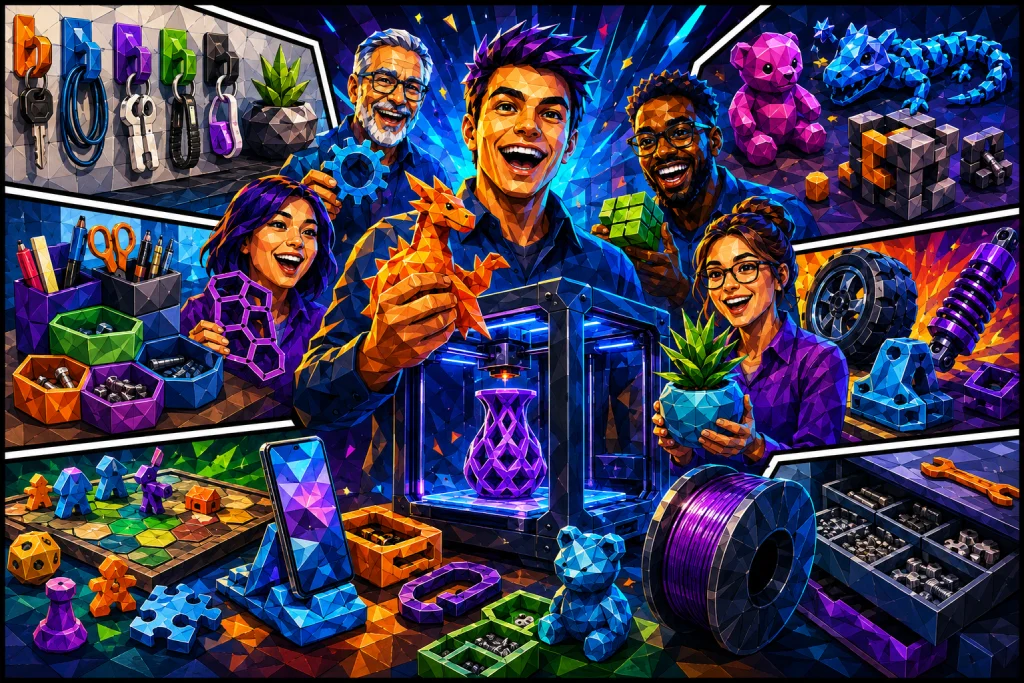
3D printing in 2026 – a revolutionary technology
3D printing has undergone rapid development in recent years and, in 2026, is both more advanced and more easily accessible than ever before. Modern printers work faster, more precisely and support a wider range of materials, giving both enthusiasts and professionals far more opportunities. With the latest software and improved hardware, users can manufacture everything from simple everyday items to complex mechanical parts with high precision.
3D printing has proven to be a defining technology in custom solutions, contributing not only creative freedom but also practical applications across many industries. In this article, we take a closer look at the most useful and innovative 3D print projects in 2026 – from functional tools and gadgets to decorative elements that can optimise your daily life and organisation.
Practical objects for everyday use
3D printing makes it possible to manufacture simple yet functional objects that can improve your daily routine. In 2026, these solutions are more well-thought-out and efficient than ever. A well-designed cable holder keeps chargers and wires organised, while a 3D-printed keyring with an engraving adds a personal touch to your belongings. A mobile stand also makes it easier to handle video calls or watch videos without having to hold the phone in your hand.
Among the more robust 3D-printed objects are plastic pegs, which now represent a genuine alternative to commercial versions. Test results show that models printed in Prusament PETG with 20% infill and three perimeters have impressive clamping force and durability. The scalability of these models makes it possible to manufacture pegs in the exact size and strength to suit your needs – whether in a workshop, a photo studio setup or for ordinary use around the home.
Organisational tools for the home and office
A well-organised workspace or home makes daily tasks easier and more manageable. 3D-printed organisational solutions allow storage systems to be customised to individual needs. For example, a custom-designed desk organiser can have dedicated compartments for pens, notebooks and USB sticks, ensuring that office supplies are always close at hand.
Wall hooks and pegs in 3D-printed designs offer flexibility in both size and mounting options. Depending on the wall type, they can be printed in PETG or ABS for extra strength, so they can hold heavier items like bags or coats without losing their shape over time.
Another innovative storage solution that has gained ground in 2026 is hexagonal storage boxes. These modular boxes can be easily stacked and combined to adapt to everything from workshops to kitchen drawers. Newer versions include lids and internal dividers, making them particularly suitable for organising small items like screws, nuts or cables.
Fun and decorative designs
Decorative 3D prints can lend a personal touch to the home or office, creating details that would otherwise be hard to find in shops. With 3D printing, you can design custom artwork and figures that are both aesthetically interesting and functional.
One of the most popular trends in 3D printing is flexi-animals – figures with movable joints that can bend and stretch without breaking. These designs are not just fun to play with, but also demonstrate how precise tolerances in 3D printing can create flexible mechanisms without the need for assembly.
Geometric sculptures have also found favour among designers and interior enthusiasts. These modern artworks can be printed in lightweight materials like PLA or in more robust filaments like PETG for greater durability. Furthermore, the designs can be adapted to different colours and surface finishes, making them ideal for sleek and minimalist interiors.
One of the more innovative solutions in 2026 is balancing hooks, which utilise weight distribution and angle calculation to hold heavy objects stably in place. This type of 3D print is a prime example of how functionality and design go hand in hand, where a simple principle can improve something as ordinary as a wall hook.
Gadgets and technological accessories
As technology develops, 3D-printed gadgets are becoming increasingly refined and versatile. With the ability to tailor solutions, users can manufacture digital aids that perfectly suit their needs.
A 3D-printed headset stand has become a practical addition for many who want to store their headphones safely whilst keeping their desk tidy. These stands can be printed in various shapes and sizes to fit both gaming headsets and smaller headphones.
For those who handle many memory cards, USB and SD card holders are an efficient way to organise digital devices. 3D printing makes it possible to create compact and modular holders that can be mounted directly on the wall or integrated into a desk organiser.
One of the most remarkable innovations in 2026 is 3D-printed ball bearings, which can be manufactured in a single complete piece without the need for additional assembly. Previously, plastic-based ball bearings were often associated with low performance levels, but new materials and precise tolerances have made it possible to produce them with a movement almost as smooth as traditional metal versions. Test results show that a little silicone grease can significantly reduce friction, making them useful in less demanding mechanical systems such as filament spools for 3D printers or light gear mechanisms.
Games and toys
3D printing gives gaming and toy enthusiasts a unique opportunity to create custom designs that are not available in traditional shops. With access to digital design files, users can easily produce game components and models to suit their needs.
Board games have been a favourite among 3D printer users for years, and in 2026 it is easier than ever to print custom-designed playing pieces, dice and card stands. These elements can be manufactured in tailored sizes and with personal engravings, allowing players to upgrade existing games or develop their own unique versions.
For those who enjoy challenging tasks, puzzles and mechanical models have become a popular category within 3D printing. Some of the most impressive designs include gear-driven puzzles and assembly kits that require precision and technical skill. These models combine play with learning and are often used to develop logical skills and motor precision in both children and adults.
One of the most notable additions in 2026 is ergonomic 3D-printed hand tools, designed to reduce strain on wrists and fingers. A particularly popular model is an ergonomic scoop, which features a curved shape that makes it easier to shovel material without putting unnecessary strain on the wrist. These tools show how 3D printing can not only create entertainment but also improve the functionality of everyday items.
Projects for hobbyists and DIY enthusiasts
For those passionate about building and experimenting, 3D printing offers a world of advanced projects that can improve both work processes and product development. In 2026, the technology is so refined that even complex mechanical components can be manufactured with great precision, allowing enthusiasts to design and optimise their own solutions.
Custom-designed screws, gears and couplings are among the most useful 3D prints for hobbyists working with prototypes and small mechanical systems. By utilising materials like PETG or ABS, these parts can be manufactured with high strength and durability, making them suitable for functional testing and adjustments in product development.
An innovative solution that has gained popularity in 2026 is an adjustable sorting tray for small hardware parts. This type of tray can be printed in various sizes, where the smallest versions have up to eight separate compartments, whilst larger variants allow for even more organisation. The clever design makes it possible to slide the sorted items straight into another container without wasting time, which is particularly useful for those who frequently work with screws, nuts or other small parts.
3D printing gives DIY enthusiasts the freedom to manufacture exactly the solutions they need – from robust tools to custom-designed components that do not exist on the market. With the right approach and material choices, even advanced projects can be realised with a 3D printer.
Frequently asked questions about the best things to 3D print in 2026
3D printing is becoming increasingly popular, and many people ask questions about which projects offer the most value. Here we have gathered the most relevant questions based on the latest trends and technological advances.
Can I 3D print mechanical parts that can be used in practice?
Yes, modern 3D printers can manufacture mechanical parts with high precision. Screws, gears and couplings can be printed in durable materials like PETG and ABS. For extra strength, you can use filaments with carbon fibre or nylon, which offer high mechanical resistance.
Which materials are best for functional 3D prints?
It depends on the application. PLA is good for decorative prints, while PETG and ABS are ideal for stronger objects like tools and brackets. TPU is used for flexible designs, and nylon or PACF provides high heat and wear resistance for technical components.
How can 3D printing be used to organise my home and office?
3D-printed organisational solutions include desk organisers, wall hooks, storage boxes and sorting trays. These can be designed to fit your exact needs, making it easier to keep track of small items like cables, screws and office supplies.
Are 3D-printed ball bearings a viable replacement for metal versions?
Yes, in certain applications. 3D-printed ball bearings work well for light mechanical systems like filament spools and small gear systems. They can be improved with silicone grease, but for high loads or precision work, traditional metal bearings are still recommended.
What are the most popular 3D-printed games and toys?
Board game components, puzzles and flexi-animals are among the most popular 3D prints for games and toys. Many people also print action figures and assembly kits with moving parts. These prints can be customised in size and colour, making them a fun hobby.
Where can I get a price for my 3D print?
You can get a price by uploading your 3D file to [3dprintpris.dk]. Here, the price is calculated based on material choice, print size and complexity, giving you an accurate assessment of what your project will cost.
Getting started with 3D printing in 2026
Never before has 3D printing been as accessible, flexible and innovative as it is in 2026. Whether you are new to 3D printing or an experienced maker, there are countless projects that can simplify your daily routine, optimise your organisation or add a creative touch to your surroundings. With advanced materials, precise printers and a wealth of design options, you can create everything from functional tools to decorative elements that fit your needs perfectly.
Technological developments have made 3D printing more efficient and cost-effective, meaning that both private individuals and businesses can reap the benefits of custom production. Whether you want to print useful gadgets, mechanical components or artistic designs, the possibilities are virtually limitless.